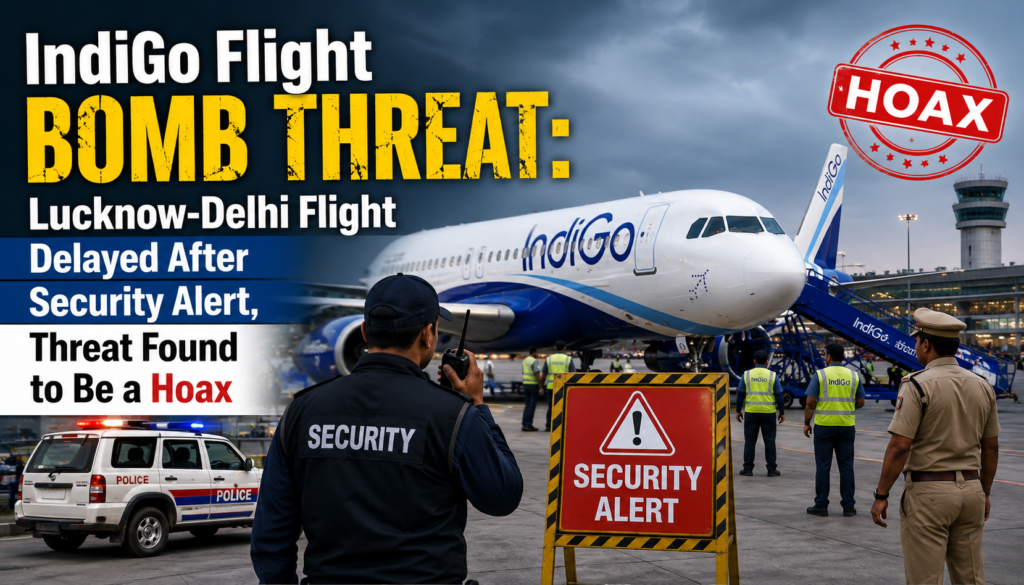
A major security scare unfolded at Lucknow’s Chaudhary Charan Singh International Airport on Friday when an IndiGo flight bomb threat led to the delay of a Delhi-bound aircraft carrying around 180 passengers. The incident triggered an immediate response from airport security agencies and airline officials, causing the flight to remain grounded while extensive safety checks were conducted.
Although the threat was later declared a hoax, authorities followed all mandatory aviation security protocols to ensure the safety of passengers, crew members, and airport personnel. The incident once again highlights the strict security measures followed by Indian aviation authorities whenever a potential threat is reported.
IndiGo Flight Delayed Before Departure
The Delhi-bound IndiGo flight, identified as flight 6E 2111, was scheduled to depart from Lucknow at approximately 10:45 AM. However, shortly before takeoff, airline staff received information indicating a possible security threat onboard the aircraft.
As soon as the alert was received, the aircraft was prevented from proceeding toward takeoff. Instead, it was held at the apron area while security agencies were informed and emergency procedures were initiated.
The IndiGo flight bomb threat immediately prompted airport authorities to activate standard security protocols. Security personnel, bomb detection teams, and aviation officials arrived at the scene to conduct a detailed inspection of the aircraft and surrounding areas.
Passengers onboard were informed about the situation and were asked to cooperate with the authorities while the necessary security procedures were carried out.
Tissue Paper Note Triggered the Security Alert
According to reports, the entire scare began after a tissue paper carrying the word “bomb” was found inside one of the aircraft’s lavatories.
The discovery of the suspicious note quickly raised concerns among airline staff. Given the sensitive nature of aviation security, even a small indication of a potential threat is treated seriously.
The note was immediately reported to airport security agencies, leading to the launch of a comprehensive investigation. The IndiGo flight bomb threat caused temporary panic among passengers and staff, although authorities maintained that all actions were being taken as a precautionary measure.
Security teams carefully inspected the aircraft to determine whether there was any genuine danger associated with the message.
Extensive Security Checks Conducted
Following the threat alert, multiple security agencies conducted a thorough search operation inside the aircraft.
Officials inspected passenger cabins, luggage compartments, cargo sections, lavatories, and other sensitive areas of the aircraft. Bomb detection squads and trained security personnel were deployed to ensure that no suspicious object remained unchecked.
Airport authorities also monitored the surrounding operational zones as part of the standard security procedure.
The IndiGo flight bomb threat led to a temporary halt in flight operations for the affected aircraft while investigators worked to verify the credibility of the warning.
Such detailed inspections are mandatory under aviation safety regulations and are designed to eliminate even the slightest possibility of risk before an aircraft is allowed to fly.
Threat Later Declared a Hoax
After an extensive search and security assessment, officials confirmed that no explosive device, bomb, or hazardous material was found onboard the aircraft.
Authorities concluded that the warning was a hoax and that there was no immediate threat to passengers or crew members.
An official involved in the investigation stated that security teams did not recover any suspicious object or explosive substance during the inspection process.
While the IndiGo flight bomb threat ultimately turned out to be false, authorities emphasized that every such alert must be treated with the highest level of seriousness until proven otherwise.
Even hoax threats can significantly disrupt airport operations, delay flights, and create unnecessary panic among travelers.
IndiGo Issues Official Statement
Following the incident, IndiGo released an official statement explaining the situation and outlining the steps taken by the airline.
According to the airline, a security-related concern was identified shortly before departure on flight 6E 2111, which was scheduled to operate between Lucknow and Delhi on June 12, 2026.
The airline stated that it immediately informed the relevant authorities and fully cooperated with all security agencies during the investigation.
IndiGo further confirmed that the aircraft would be allowed to continue its journey only after receiving all required security clearances from the concerned authorities.
The airline also expressed regret for the inconvenience caused to passengers and assured them that efforts were being made to minimize disruptions.
To assist travelers affected by the delay, IndiGo reportedly provided refreshments and regular updates regarding the progress of the security checks.
The airline reiterated that passenger safety and security remain its highest priorities.
Also Read : NEET UG 2026 Re-Exam Controversy Deepens, Key NTA and NMC Officials to Face Parliamentary Probe
Passengers Faced Delays but Safety Remained the Priority
The IndiGo flight bomb threat resulted in considerable delays for passengers traveling from Lucknow to Delhi. Many travelers had to wait while authorities completed the security screening process.
Despite the inconvenience, passengers generally cooperated with airline staff and security officials throughout the operation.
Aviation experts note that such delays are unavoidable whenever a potential security threat emerges. Even when a threat appears minor, authorities cannot take any chances due to the serious consequences that could arise from overlooking suspicious activity.
Security protocols are designed to prioritize human safety over operational schedules, ensuring that every flight is thoroughly checked before departure.
Growing Concern Over Hoax Threats in Aviation
The latest IndiGo flight bomb threat is part of a broader trend of aviation security scares reported across India and other countries in recent years.
Several flights have experienced delays, emergency landings, or security inspections after receiving anonymous bomb threats, suspicious messages, or alarming notes left onboard aircraft.
While many of these incidents eventually turn out to be hoaxes, they continue to place significant pressure on airlines, airport authorities, and security agencies.
False threats not only disrupt travel plans but also consume valuable security resources that could otherwise be used to address genuine risks.
Authorities frequently remind the public that making false bomb threats is a serious criminal offense and can lead to strict legal action, including imprisonment and financial penalties.
Also Read : Delhi-NCR Weather Alert: IMD Predicts 90 km/h Winds, Heavy Rain and Thunderstorms Today
Investigation Continues
Although no explosive substance was found on the aircraft, authorities are continuing their investigation to determine who left the tissue paper note inside the lavatory.
Security agencies are expected to review CCTV footage, passenger movement records, and other relevant evidence to identify the individual responsible for triggering the alert.
Investigators will examine whether the act was intended as a prank or if there were other motives behind the incident.
The findings of the investigation could lead to legal proceedings against those responsible for causing the security scare.
Conclusion
The IndiGo flight bomb threat involving flight 6E 2111 from Lucknow to Delhi caused significant disruption on Friday after a tissue paper bearing the word “bomb” was discovered inside the aircraft’s lavatory. The alert prompted an immediate security response, resulting in a thorough inspection of the aircraft and a delay in departure.
Fortunately, authorities found no explosive device or harmful substance during the investigation and later declared the threat a hoax. Despite the inconvenience faced by nearly 180 passengers, the incident demonstrated the effectiveness of aviation security protocols and the commitment of authorities to passenger safety.
As investigations continue to identify the person responsible for the false alarm, the case serves as a reminder that even seemingly minor threats are taken extremely seriously in modern aviation, where safety remains the top priority.