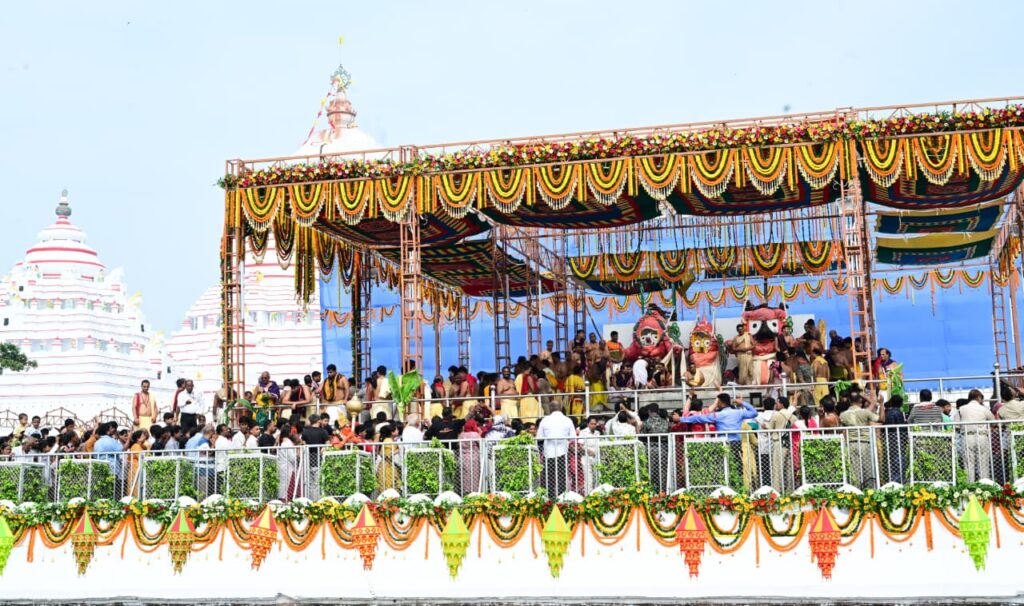
Snana Yatra 2026 witnessed an overwhelming turnout of devotees as lakhs of pilgrims gathered in the holy city of Puri, Odisha, on Monday to participate in one of the most significant rituals associated with Lord Jagannath. Also known as Snana Purnima or Deva Snana Purnima, the annual festival marks the ceremonial bathing of Lord Jagannath, his elder brother Lord Balabhadra, and sister Devi Subhadra at the revered Jagannath Temple.
The grand event is considered the official beginning of the preparations for the world-famous Rath Yatra, which is scheduled to commence on July 16, 2026. Every year, devotees from across India and abroad visit Puri to witness this sacred ceremony, making Snana Yatra 2026 one of the most spiritually significant festivals in the Hindu calendar.
Lakhs of Devotees Arrive in Puri for Snana Yatra 2026
From the early hours of the morning, thousands of devotees started gathering around the Jagannath Temple and the Snana Vedi (bathing platform). The temple town of Puri was filled with chants of “Jai Jagannath” as pilgrims eagerly waited to witness the divine bathing ceremony of the sibling deities.
The annual festival attracts devotees from different parts of Odisha, neighboring states, and even international visitors who come to experience the rich traditions and spiritual atmosphere of the Jagannath Temple.
Authorities made extensive arrangements to ensure smooth crowd movement, allowing devotees to participate in the rituals peacefully.
Ceremonial Pahandi Bije Procession Marks the Beginning
The celebrations of Snana Yatra 2026 began with the traditional Pahandi Bije procession, during which the idols of Lord Jagannath, Lord Balabhadra, and Devi Subhadra were ceremoniously carried from the temple’s sanctum sanctorum to the Snana Vedi.
The colorful procession featured temple servitors carrying the deities amidst the rhythmic beats of traditional drums, conch shells, cymbals, and gongs. Thousands of devotees watched the procession with great devotion, offering prayers as the deities were brought to the bathing platform.
The Pahandi procession remains one of the most iconic rituals of the Jagannath tradition and symbolizes the Lord coming out to bless devotees.
108 Pitchers of Sacred Water Used for the Holy Bath
One of the main highlights of Snana Yatra 2026 was the ceremonial bathing of the deities using 108 pitchers of fragrant holy water.
The sacred water was drawn from the temple’s revered Sunakua (Golden Well), a well considered highly auspicious within the Jagannath Temple complex. Temple priests and servitors performed elaborate Vedic rituals before bathing the deities between noon and 2 p.m.
The number 108 holds immense spiritual importance in Hinduism and is considered sacred in religious ceremonies, making this ritual deeply symbolic for devotees.
The grand bathing ceremony represents purification, divine blessings, and the spiritual renewal of the deities before the annual Rath Yatra.
Gajanana Besha: The Famous Hathi Besha Ritual
Following the ceremonial bath, Lord Jagannath, Lord Balabhadra, and Devi Subhadra were adorned in the famous Gajanana Besha, popularly known as Hathi Besha.
During this unique ritual, the deities are decorated with beautifully crafted elephant-shaped masks and special ornaments. This divine appearance is believed to represent Lord Ganesha and attracts thousands of devotees every year.
The Hathi Besha is considered one of the most visually spectacular traditions associated with Snana Yatra 2026, drawing large crowds eager to witness this rare form of the deities.
Why the Deities Go into Anasara After Snana Yatra
According to centuries-old Jagannath Temple traditions, the deities are believed to develop a fever after receiving the ceremonial bath.
As a result, they are shifted to the Anasaragruha, also known as the isolation chamber, where they remain away from public view for approximately two weeks.
During this period, known as Anasara, only the temple’s Daita and Pati servitors are permitted to serve the deities. Devotees are unable to have darshan during this time, as the deities are believed to be recovering.
This unique tradition highlights the human-like characteristics associated with Lord Jagannath and is one of the defining features of the Jagannath culture.
Naba Jaubana Darshana Before Rath Yatra
After the Anasara period concludes, the deities reappear before devotees in a rejuvenated form during the Naba Jaubana Darshana.
This special darshan symbolizes renewed youth and divine energy before Lord Jagannath, Lord Balabhadra, and Devi Subhadra embark on the grand Rath Yatra 2026.
Thousands of devotees eagerly wait for this occasion every year, as it marks the first public appearance of the deities after their period of seclusion.
Odisha Chief Minister Offers Prayers During Snana Yatra 2026
Odisha Chief Minister Mohan Charan Majhi visited Puri on the occasion of Snana Yatra 2026 and offered prayers at the Snana Vedi.
Speaking to the media after seeking blessings, the Chief Minister expressed happiness at getting the opportunity to witness the sacred festival.
He prayed for the peace, prosperity, and well-being of the people of Odisha as well as devotees across the world. He also sought Lord Jagannath’s blessings for the successful and smooth conduct of the upcoming Rath Yatra.
Following the prayers, the Chief Minister reviewed the ongoing construction work of the three massive wooden chariots that will be used during Rath Yatra.
Massive Security Arrangements in Puri
Considering the enormous turnout during Snana Yatra 2026, Odisha Police implemented extensive security and crowd management measures across Puri.
The deployment included senior police officers, Additional Superintendents of Police, Deputy Commandants, Deputy Superintendents of Police, Inspectors, Sub-Inspectors, Assistant Sub-Inspectors, and nearly 79 platoons of police personnel.
Specialized units were also deployed to monitor crowd movement, maintain law and order, and ensure that devotees could participate in the festival safely.
Authorities also coordinated traffic management, emergency medical services, and surveillance systems throughout the temple town to handle the massive influx of pilgrims.
Significance of Snana Yatra 2026
Snana Yatra 2026 is much more than a ceremonial bathing festival. It represents devotion, purification, renewal, and the beginning of one of India’s largest religious celebrations—the Jagannath Rath Yatra.
For devotees, witnessing the sacred bath of Lord Jagannath is considered highly auspicious and spiritually rewarding. The festival also showcases Odisha’s rich cultural heritage, centuries-old temple traditions, and the deep faith associated with Lord Jagannath.
As preparations now move toward the grand Rath Yatra 2026, the successful completion of Snana Yatra 2026 marks another important chapter in the annual religious calendar of Puri, drawing millions of devotees closer to one of Hinduism’s most revered traditions.
Conclusion
Snana Yatra 2026 once again showcased the deep spiritual devotion and cultural heritage associated with Lord Jagannath and the sacred traditions of Puri. The grand ceremonial bathing of Lord Jagannath, Lord Balabhadra, and Devi Subhadra attracted lakhs of devotees from across the country, reaffirming the festival’s significance in the annual Jagannath calendar.
With the successful completion of the Snana Yatra rituals, attention now shifts to the much-awaited Rath Yatra 2026, one of the world’s largest and most celebrated religious festivals. As the deities enter the Anasara period before reappearing for the Naba Jaubana Darshana, devotees eagerly await the opportunity to witness the grand chariot festival. The seamless arrangements by the temple administration and Odisha authorities have ensured that Snana Yatra 2026 concluded peacefully, setting the stage for another spiritually enriching Rath Yatra celebration.