India is seeing a pretty uneven southwest monsoon in 2026, with rain showing up in very different ways across states and nearby regions. the India Monsoon Rainfall Deficit has become a big weather issue, because even though there was a bit of a temporary recovery in July, the cumulative rainfall is still running below what’s normal. this matters a lot for agriculture, water supplies, groundwater recharge, and basically for rural livelihoods that rely on monsoon season rain.
India Monsoon 2026: What the Rainfall Looked Like So Far
Since the southwest monsoon arrived, 2026 has been far from uniform. Some places got heavy, even above normal rainfall for a while, while others dealt with longer dry spells, and then they also faced noticeable shortages in rainfall. because of this mismatch in where the rain lands, the countrywide numbers can make it look better than what many individual states, or even districts, are actually dealing with.
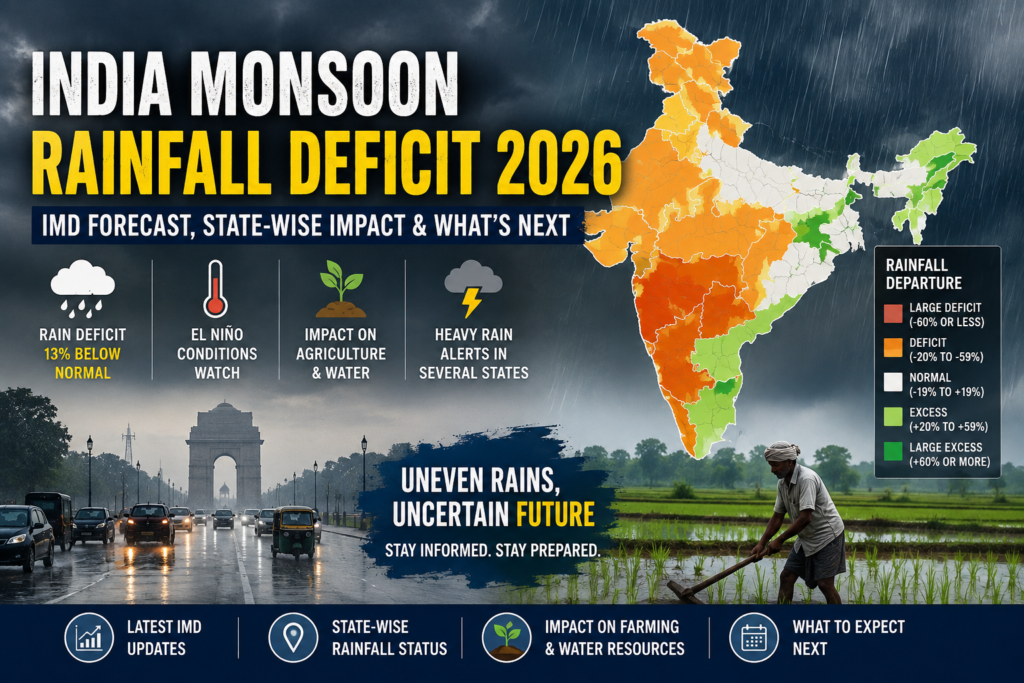
Recent updates say that by mid August, India’s cumulative monsoon rainfall was about 13% below normal. In July there was a partial easing, with rainfall hovering near normal or just a little higher at the national level. still, that improvement wasn’t enough to fully erase the earlier shortfall that built up during the season.
So, the India Monsoon Rainfall Deficit really should be reviewed together with how rain is spreading state wise, how the dry spells are behaving, and where the stronger, more extreme rainfall events are happening.
Why Is the Rainfall Deficit Important?
The southwest monsoon is kinda critical for India’s economy, because agriculture, water availability and several other sectors hinge on seasonal rainfall. A big share of India’s farmland depends on rainfall rather than assured irrigation, so yeah the stakes are real.
If rainfall stays below normal for extended periods, farmers can struggle to keep enough soil moisture, and that hits crop growth pretty badly. At the same time, reduced rainfall isn’t only an “on-field” problem— it can also affect reservoirs, groundwater recharge, drinking-water supplies and hydropower output.
Still, a rainfall deficit doesn’t automatically mean every area will slide into drought. There can be short stretches of extremely intense rain between longer dry spells, so you may end up with a strange mix of water scarcity and flooding. It’s not always straightforward.
IMD Monsoon Forecast 2026
The India Meteorological Department (IMD) keeps tracking rainfall activity, atmospheric circulation, and broad climate signals to judge how the southwest monsoon is progressing.
According to the IMD, there is a possibility of below-normal rainfall during parts of the August–September window. Conditions are likely to stay quite changeable, with some pockets getting heavy rainfall, and other pockets seeing below-normal precipitation.
One element being observed very closely is the potential strengthening of El Niño conditions. Shifts in Pacific Ocean temperatures can steer atmospheric circulation, and that can influence how well India’s monsoon performs.
So the India Monsoon Rainfall Deficit shouldn’t be treated as just a national rainfall percentage number. The schedule, plus the spatial spread of rainfall across regions, matters just as much, even if it sounds a bit less simple at first.
\State-Wise Impact of Rainfall Deficit
Rainfall results, really vary from state to state. In some places people have seen a good amount of precipitation, while in other regions the pattern is still not great, meaning they’re dealing with a rainfall deficit.
Goa, for instance, was said to have a noticeable rainfall shortfall by mid-August. Then Vidarbha in Maharashtra has also gone through stretches of deficient rainfall after monsoon breaks started showing up.
Meanwhile, Odisha, Kerala, and the Western Himalayan region have either already had or are being forecast to get bouts of heavy rainfall.
That mixed picture shows an important thing about India’s 2026 monsoon, heavy rain happening in one area doesn’t automatically wipe out the seasonal deficit elsewhere. So state-wise monitoring matters a lot, because it helps explain the real effects of the monsoon, on the ground.
Impact on Indian Agriculture
Agriculture is likely to stay, one of the most affected areas whenever there is an India Monsoon Rainfall Deficit.
Crops like soybean, cotton, maize, pulses, and several other rain-dependent crops need steady moisture across different phases of growth. If dry spells stretch longer than usual, crop stress can rise a lot, especially when rainfall turns inconsistent, right after sowing.
However, it’s also true that too much rainfall too fast can lead to waterlogging, harm to crops and soil erosion.
Because of that farmers really need to follow local weather forecasts, not only the national level rainfall statistics. When district-level rainfall information is used well, it can support better choices for irrigation, crop protection, and day to day field management.
Rainfall Deficit and also Extreme Rainfall: how can both show up?
Basically one big point about India Monsoon Rainfall Deficit is that the seasonal rainfall total can stay under usual levels, even if parts of the country see very heavy rainfall at the same time. It sounds a bit odd, but it happens.
Like, a specific area might get a cluster of days with intense rain, then suddenly it can go two or three weeks with far less precipitation. Those intense spells can trigger short lived flooding, yet the longer quiet stretch still drags the whole season’s numbers down, leading to a rainfall deficit for the season.
So it kind of shows, that the way rain is spread out, really matters almost as much as the full amount. Total rainfall and its timing can’t be treated like they’re the same thing.
Also climate change is pulling more focus onto rainfall swings, and on extreme weather episodes. When rain becomes stronger but over fewer hours or days, it can stress urban drainage systems, complicate agriculture, and make water management harder.
What could happen next?
The coming weeks will matter a lot for whether India’s cumulative rainfall deficit can shrink, before the southwest monsoon starts to withdraw.
Low pressure systems over the Bay of Bengal may temporarily ramp up rainfall activity across central,eastern and northern India. Still, the end result will depend on how often these systems appear, and how strong they are, plus the wider conditions in the atmosphere.
The IMD will keep putting out rainfall updates, weather warnings, and regional forecasts so authorities and people can stay ready for shifts that come fast.
For farmers, businesses, and policymakers, watching the IMD monsoon forecast 2026 along with state-wise rainfall details and short term weather alerts will likely help more than only leaning on the national rainfall average.
What does the monsoon deficit mean for India?
The India Monsoon Rainfall Deficit can have various consequences depending on how the rain starts behaving during the rest of the monsoon period, like it may shift in time not only in amount.
If the deficit keeps going, it could add pressure on agriculture that depends on regular rainfall, and also on water supplies. Still if things look better late in the season, even a bit, that may shrink the overall gap, and help soil moisture and reservoirs in multiple parts of the country.
So the main problem isn’t only whether India gets more rain. It’s also where it lands, when it arrives, and how strong, or intense, those downpours actually are.
Also Read More About: Why Is Khait Parvat Called the Land of Aanchari? The Untold Legend of Uttarakhand
Conclusion
The India Monsoon Rainfall Deficit in 2026 points to a complicated, uneven setup, not just one simple lack of rain everywhere. Even though July brought some improvement, cumulative rainfall stayed under normal by mid-August, and the differences between states and regions were pretty large.
The next few weeks will matter a lot. Shifts in monsoon circulation, rainfall patterns, and broader climate conditions could decide whether the deficit tightens again, or carries on, with little change.