
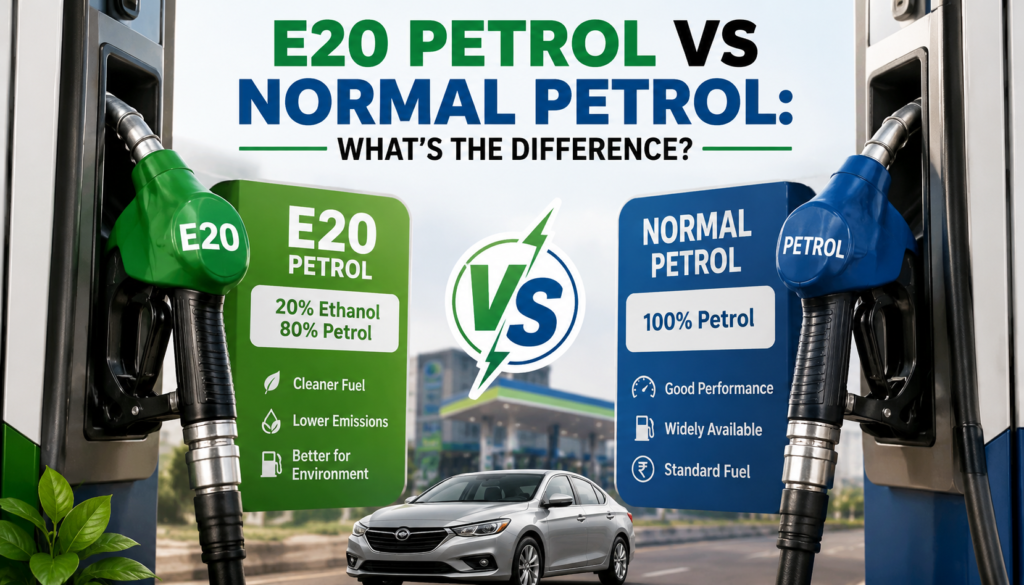
Fuel is one of the most important factors in the running cost and performance of a petrol vehicle. With E20 petrol becoming increasingly common in India, many car and bike owners are wondering how it differs from the petrol they have used for years.
The main difference is the amount of ethanol blended into the fuel. E20 contains 20% ethanol and 80% petrol, while conventional petrol may contain a lower percentage of ethanol depending on the fuel blend.
So, when comparing E20 Petrol vs Normal Petrol, the biggest questions are about mileage, performance, engine compatibility, cost, and environmental impact.
What Is E20 Petrol?
E20 petrol is a blend containing 20% ethanol and 80% gasoline. Ethanol is a renewable biofuel that can be produced from agricultural sources such as sugarcane, maize and other biomass.
India has been increasing ethanol blending in petrol as part of its effort to reduce dependence on imported fossil fuels and promote renewable fuel sources. IndianOil began selling E20 at selected outlets in 2023 and subsequently expanded its availability across the country.
The “E” in E20 refers to ethanol, while “20” represents the approximate ethanol content in the blend.
What Is Normal Petrol?
Normal petrol usually means fuel with a lower ethanol mix compared to E20, but the exact ratio depends on what’s being sold in that specific market at that point in time. Traditionally, the so called “petrol” was mostly gasoline based, but in India the shift has been more and more toward greater ethanol blending over time.
For customers, this basically means the gap between older petrol and today’s E20 isn’t just in the wording or the label. The amount of ethanol can change a few fuel traits, like the energy yield, and also how well it fits with vehicle parts and materials, not always the same way as before.
E20 Petrol vs Normal Petrol: Key Differences
When comparing E20 Petrol vs Normal Petrol, there are several important differences to understand.
| Feature | E20 Petrol | Normal Petrol |
| Ethanol content | Up to 20% | Lower or different blend |
| Petrol content | Around 80% | Higher percentage |
| Renewable component | Higher | Lower |
| Fuel economy | Can vary by vehicle | Generally higher energy content per litre |
| Compatibility | Best with E20-compatible vehicles | Depends on vehicle and fuel specification |
| Environmental benefits | Can reduce reliance on fossil fuels | Higher fossil-fuel dependence |
1. Ethanol content
The most obvious difference, is ethanol content. E20 has 20% ethanol and 80% petrol, pretty straightforward really.
Ethanol is an oxygenated fuel, sort of that means it can help with cleaner burning and also reduce reliance on petroleum based fuel.
2. Mileage
Mileage is one of those biggest concerns for vehicle owners. Like, people worry about it a lot.
Ethanol includes less energy per litre than gasoline, so if you use a higher ethanol blend you might see a drop in fuel efficiency. The size of the effect depends on the vehicle itself, its engine technology, driving conditions, and even the vehicle’s age.
In July 2026, Union Minister Nitin Gadkari said in Parliament that E20 can reduce fuel efficiency by around 2% to 6% , depending on the vehicle category and age. He also mentioned that wide testing did not show evidence of engine failures caused by E20
So, basically, the mileage difference should not be taken as the same for every car or bike, because it really varies.
3. Vehicle compatibility
Compatibility is another important angle when comparing E20 Petrol vs normal Petrol.
Newer vehicles designed or certified for E20 are made with fuel system components and engine calibration that matches the blend. Older vehicles, might have been designed around lower ethanol percentages, more or less.
If you have an older car or motorcycle, check the manufacturer’s owner manual, or official compatibility details before assuming anything about long-term use.
4. Engine performance
For a vehicle that is E20 compatible, E20 is supposed to work the way the manufacturer intended. In many cases you might not notice a huge day-to-day difference.
But fuel properties can influence mileage and engine behaviour in different ways across models. Things like engine design, tuning, maintenance, traffic, and driving style also matter a lot, almost more than people expect.
Also Read : Apple iPhone 18 Launch Date: Is It Worth Waiting or Buying the iPhone 17 Pro Now?
Is E20 Petrol Better for the Environment?
One of the main reasons pushing for higher ethanol blending is its possible environmental plus energy-security benefits.
Ethanol itself comes from renewables, and if it’s blended with petrol, you can use less of the usual fossil fuels. IndianOil says E20 could cut greenhouse-gas emissions and also some other pollutants, like carbon monoxide , relative to regular petrol.
So E20 can fit with India’s wider turn toward renewable fuel sources, even while the current fleet of petrol vehicles keeps going like normal.
Still, the green advantages should be judged across the whole fuel-production process, not just on what shows up at the vehicle exhaust, only.
Is E20 Petrol Safe for Cars and Bikes?
If the vehicle is E20 compatible then the fuel is intended for standard use, in practice.
The more pressing matter is whether your specific vehicle actually supports E20. Automakers have increasingly rolled out E20-compatible models, though older cars might differ in their compatibility spec’s, or they might be clear but only in certain years.
If you are not sure, check,
– Your vehicle owner’s manual
– The manufacturer official website
– The fuel compatibility label, or the details supplied with the vehicle
– A authorised service centre
Don’t lean only on general info either because compatibility can vary by model and manufacturing year.
E20 Petrol vs Normal Petrol: Which Is Better?
There is no single answer for every vehicle.
If your vehicle is designed for E20, using E20 petrol should be appropriate according to the manufacturer’s specifications. Its higher ethanol content supports India’s renewable-fuel and energy-security goals.
If you have an older vehicle, compatibility should be your first consideration. Mileage can also differ because E20 contains more ethanol and therefore has lower energy content per litre.
So, rather than asking which fuel is universally better, vehicle owners should ask which fuel is recommended for their specific vehicle.
Does E20 Petrol Cost Less?
A lower price at the fuel station does not automatically mean lower running costs.
Since E20 can affect fuel efficiency, vehicle owners should consider cost per kilometre, rather than only the price displayed at the petrol pump.
For example, if two fuels have different prices but one provides slightly lower mileage, the difference in actual running cost may be smaller—or larger—than expected.
Your vehicle’s real-world mileage is therefore more useful than comparing fuel prices alone.
How to Know If Your Vehicle Supports E20
If you just bought a car or maybe a bike, take a moment and check the official specifications for whether E20 is compatible or not.
For older models, it’s wise to open the owner’s manual, or simply get in touch with the manufacturer. Some brands also publish info depending on the manufacturing year, so that can help.
Honestly it’s better to double-check compatibility first, before you decide on anything, especially if you’re driving an older petrol vehicle.
Also Read : Samsung Galaxy F70 Pro 5G: Latest Leaks, Expected Price, Specifications, Features & India Launch Timeline
Conclusion
The whole debate around E20 Petrol vs Normal Petrol is mostly , really about the ethanol percentage, whether it fits your vehicle, how many kilometers you get per liter, and also the environmental angles.
E20 basically has 20% ethanol and 80% petrol , and it has slowly turned into a bigger piece of India’s fuel scene.
If your vehicle is E20 compatible, then it is a kind of planned fuel option. But owners should still keep, sort of realistic expectations for mileage, because a higher ethanol portion can bring some loss of efficiency, in certain vehicles , depending on how it’s set up.
So the easiest path is not complicated: read what the vehicle manufacturer says, watch your day to day mileage, and then pick the fuel your vehicle was meant to use.