
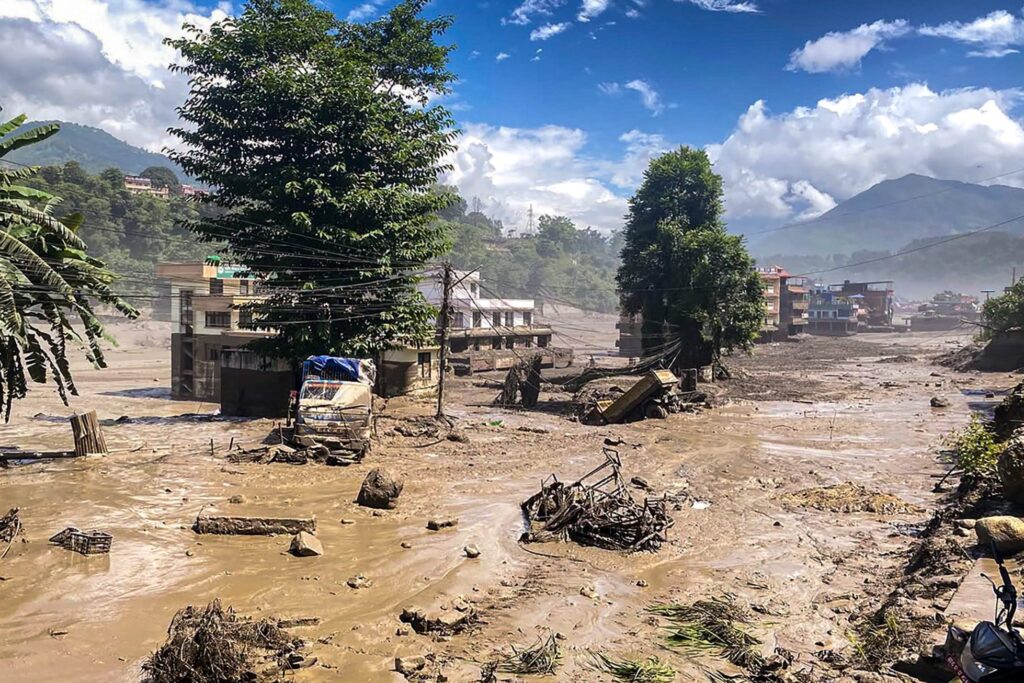
The Nepal Floods have created a heartbreaking situation across several parts of the country, with rescue teams still recovering people who were swept away by powerful floodwaters. As more bodies are found downstream, authorities are facing another difficult task: finding enough space to store the remains and identify victims. In response, officials are using temporary morgues, dry ice, photographs, fingerprints, DNA testing and identification tags to manage the situation.
The disaster has affected communities along the Bhotekoshi and Trishuli river systems, while bodies have been recovered much farther downstream in districts such as Chitwan, Tanahun, Gorkha and Nawalparasi. For families waiting for news about missing relatives, the recovery and identification process has become an emotional and uncertain journey.
Nepal Floods Push Morgues Beyond Their Capacity
One of the biggest challenges following the Nepal Floods is the lack of space in hospital morgues.
Bodies recovered from northern districts are being transported downstream as rescue and search teams continue their work. Several hospitals in Nuwakot, Dhading, Nawalparasi and other areas have already struggled to accommodate the number of bodies being brought in.
Chitwan has been particularly affected. Authorities are preparing a temporary body-storage centre in Bharatpur after the number of recoveries exceeded the capacity of local hospital morgues. Existing facilities in the district can accommodate only around 30 to 50 bodies, while the temporary centre is expected to provide space for about 250.
The situation is similar in Pokhara, where bodies transported from several districts have also put pressure on available morgue space.
Why Authorities Are Using Dry Ice
Keeping recovered bodies in suitable conditions is another major concern. Hospitals in Pokhara are currently storing remains at temperatures between 2°C and 6°C. Officials say this type of storage can generally preserve bodies for around 10 days to two weeks. Longer preservation would require facilities capable of maintaining temperatures below freezing.
Because cold-storage facilities are limited, authorities are turning to temporary solutions. Dry ice is being arranged to help slow decomposition at temporary storage locations.
In Chitwan, local business organisations have agreed to help arrange dry ice for the temporary facility. Air conditioners are also being installed to help maintain a suitable temperature inside the building.
The use of dry ice is not a replacement for proper long-term morgue facilities, but it can provide authorities with additional time while identification and recovery work continues.
DNA Testing Becomes Important for Victim Identification
Identifying victims has become one of the most difficult parts of the disaster response. Many people were swept away from their original locations, and some bodies have been recovered far from where the victims were last seen.
Police and medical teams are therefore using several methods to establish identities. These include:
- Taking photographs of recovered bodies
- Recording fingerprints
- Conducting post-mortem examinations
- Collecting DNA samples
- Comparing information with missing-person reports
- Sharing photographs where visual identification is possible
- Assigning identification numbers and tags
DNA testing is particularly important when a victim cannot be identified through photographs, fingerprints or personal belongings. Samples that require further examination can be sent to specialised laboratories in Kathmandu.
Body Tags Help Authorities Keep Track of Unidentified Victims
Another important part of the response is keeping detailed records of unidentified bodies.
Authorities are assigning tag numbers to recovered remains and recording information about where each body is stored or eventually buried. This creates a record that can potentially help families identify relatives later, even if an immediate identification is not possible.
This process is especially important because authorities may not be able to keep unidentified remains in hospital morgues indefinitely. Under Nepal’s guidelines for unidentified and unclaimed bodies, officials are preparing procedures for secure burial while retaining identification information, including fingerprints and DNA samples.
Families Travel in Search of Missing Relatives
Behind every unidentified body is a family waiting for answers. Relatives of missing people have been travelling from districts including Rasuwa, Nuwakot and Gorkha to areas such as Chitwan in the hope of finding information.
For many families, the uncertainty is particularly painful. They may not know whether a missing relative has survived, been rescued, or is among those recovered by authorities.
Officials are using photographs and other identification methods to help families search for their loved ones. Where visual identification is not possible, DNA testing may become the most reliable way to establish a person’s identity.
Nepal Floods Continue to Create Rescue Challenges
The recovery effort is also being complicated by difficult terrain, damaged infrastructure and the risk of further flooding.
On August 28, a landslide-created lake near the Nepal-China border began overflowing, raising concerns about another surge of water entering the Bhotekoshi River. Rescue operations were temporarily disrupted in some areas as authorities issued warnings and moved people away from vulnerable locations.
This means rescue teams are facing a difficult balance between searching for survivors and protecting themselves from another possible flood.
What Happens Next?
The Nepal Floods recovery operation is expected to continue as teams search rivers, damaged communities and downstream areas for survivors and missing people.
At the same time, authorities will have to manage the growing number of recovered bodies, arrange suitable storage and complete identification procedures. Temporary facilities, dry ice, body bags, identification tags and DNA testing are helping officials deal with the immediate pressure, but the scale of the disaster remains enormous.
For families, the identification process is more than an administrative task. It is the final step toward receiving answers about loved ones who have disappeared.
Also Read More About: Nepal Flood Explained: Glacier Collapse Raises Fresh Warning for India
Final Takeaway
The Nepal Floods have developed into not only a major rescue operation but also a serious humanitarian and identification challenge. With hospital morgues reaching capacity, authorities are creating temporary facilities and using dry ice to preserve recovered bodies while forensic teams work to identify victims.
The use of DNA testing, fingerprints, photographs and body tags can help authorities maintain accurate records and give families a better chance of finding their missing relatives.
As rescue and recovery operations continue, the priority remains clear: find survivors, recover those who are missing, identify victims respectfully and provide affected families with reliable information. The situation is still developing, so casualty figures and recovery details may change as teams reach more affected areas.

Pingback: India GDP Growth Rate Q1 FY27: Latest GDP Data, Expectations & What It Means - blogs.digitalgrowth.media
Pingback: Tomorrow’s Weather: A Monster System Is Forming Over UP-Bihar, Set to Unleash Havoc in the Next 20 Hours, IMD Warning for 21 States - blogs.digitalgrowth.media
Pingback: India’s Monsoon Is Leaving — But It Has One More Story to Tell - blogs.digitalgrowth.media