
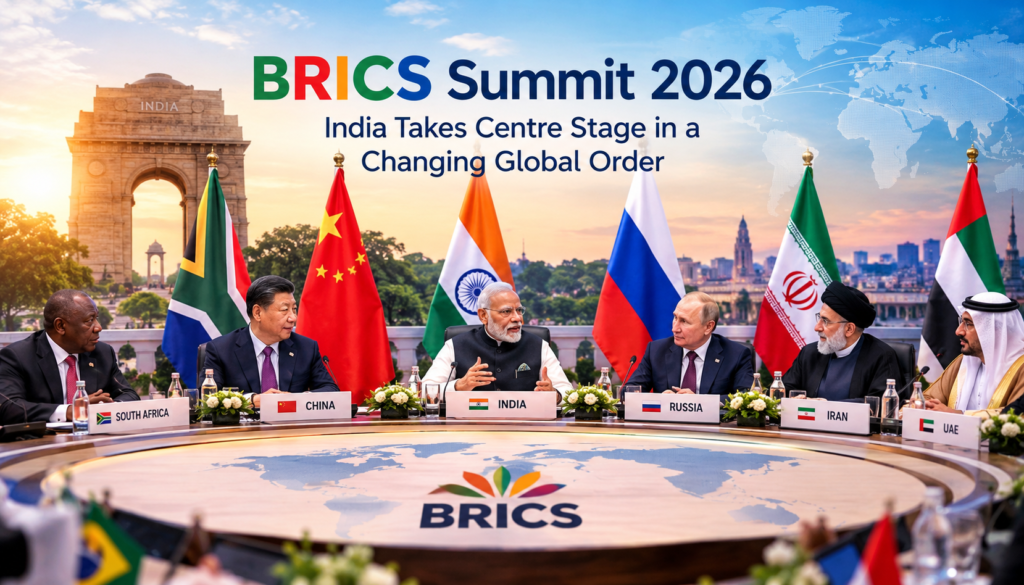
Delhi found itself at the centre of global diplomacy this weekend as some of the world’s most influential leaders gathered for the BRICS Summit 2026. Around the table were countries with very different political interests, economic priorities and, in some cases, complicated histories with one another.
Yet they came together under one platform to discuss a question that is becoming harder to ignore: what should the global order look like in the years ahead?
Prime Minister Narendra Modi called on BRICS nations to become increasingly “rule-shapers” rather than “rule-takers”. It was a statement that captured the larger ambition behind the summit — giving emerging economies a stronger voice in decisions that affect the world.
But bringing these countries together was only the first challenge. Finding common ground was another matter entirely.
BRICS Is No Longer the Same Group It Once Was
When BRICS was first formed by Brazil, Russia, India, China and South Africa, it was largely viewed as a grouping of major emerging economies with growing economic influence.
Today, the picture is considerably larger.
The BRICS expansion has brought more countries from Asia, Africa and the Middle East into the group, increasing its economic and geopolitical reach. With a larger membership comes a greater opportunity to influence discussions around international trade, finance, development and global governance.
But there is also a complication: more members mean more interests to balance.
For countries such as China, Russia and Iran, BRICS can serve as a platform for reducing dependence on Western-dominated institutions and strengthening cooperation among emerging economies. India, however, has been careful not to position the organisation as an anti-Western alliance.
That difference is important.
India’s Balancing Act
India’s role in BRICS is perhaps one of the most interesting aspects of the summit.
New Delhi maintains close strategic ties with the United States and Europe while also retaining its long-standing relationship with Russia. At the same time, India and China continue to navigate unresolved tensions along their disputed border.
These relationships do not always fit neatly together.
India’s approach has therefore been less about choosing one side and more about maintaining room to work with different countries. This idea of strategic autonomy has become an important part of India’s foreign policy.
The India BRICS Summit offered another opportunity to put that approach into practice.
Rather than turning BRICS into a platform against the West, India has presented it as a space where emerging economies can cooperate on areas of shared interest while continuing to maintain relationships outside the group.
In a world increasingly divided by geopolitical tensions, that flexibility could prove valuable.
The New Delhi Declaration: What It Says — and What It Doesn’t
One of the summit’s key outcomes was the adoption of the New Delhi Declaration.
Reaching a joint declaration was significant because earlier ministerial meetings had struggled to achieve consensus on some major issues. This time, however, the BRICS members managed to agree on a common document.
The language was carefully chosen.
On the conflict in the Middle East, the declaration called for maximum restraint and condemned attacks on civilian infrastructure and peaceful nuclear facilities. It also reaffirmed support for a two-state solution and opposed forced displacement.
However, it stopped short of directly assigning blame.
The same caution could be seen in its discussion of trade. The declaration expressed concern about rising tariffs and unilateral sanctions without directly naming the United States.
That may sound like diplomatic wording, but it reveals something important about BRICS itself.
The members may agree that parts of the existing global system need to change, but they do not necessarily agree on how that change should happen.
Why Global Trade Is Becoming a Major BRICS Issue
Economic cooperation remains at the heart of the BRICS Summit.
The combined economic weight of the BRICS countries gives the group considerable potential influence over global trade and investment. As international commerce becomes increasingly affected by tariffs, sanctions and geopolitical tensions, discussions about alternative economic partnerships are gaining momentum.
One area that continues to attract attention is the use of national currencies in international trade.
The idea is relatively straightforward: BRICS members could increase trade using their own currencies rather than relying as heavily on traditional international payment systems.
Turning that idea into a fully functioning alternative, however, would be much more difficult.
The member countries have different currencies, financial systems, economic structures and monetary policies. Building deeper financial integration would require years of coordination.
For India, the opportunity comes with a balancing act of its own. Greater BRICS economic cooperation could strengthen India’s position among emerging economies, but India also has strong economic interests in Western markets.
The challenge will be finding a way to expand cooperation without unnecessarily limiting those relationships.
A Stronger Voice for the Global South
The significance of BRICS goes beyond its member countries.
For decades, many developing nations have argued that international institutions do not adequately reflect the current distribution of global economic power. Organisations created when Western economies dominated global output continue to play a major role in international decision-making.
The world, however, has changed.
Countries across Asia, Africa and Latin America are becoming increasingly important to global growth, trade and investment. This has created growing demand for greater representation in institutions such as the International Monetary Fund, World Bank and United Nations.
BRICS has become one of the platforms through which that demand is being expressed.
Its members have increasingly spoken about creating a more multipolar world, where economic and political influence is distributed among a wider group of countries rather than concentrated in a few traditional powers.
That does not necessarily mean replacing the existing global system overnight. Instead, it could mean gradually giving emerging economies more influence within it.
Also Read : Colombia Earthquakes: Latest Tremors, Magnitude, Epicenter & Updates
Can BRICS Turn Its Ambition Into Action?
This is where the future of BRICS becomes uncertain.
The group has economic weight, a growing membership and an increasingly prominent place in international diplomacy. But influence on paper is not the same as practical cooperation.
The differences between its members are impossible to overlook.
India and China have their own strategic tensions. Russia’s relationship with the West remains deeply strained. Iran faces its own geopolitical challenges, while other BRICS members have different priorities and foreign-policy interests.
BRICS, therefore, is unlikely to function like a traditional political or military alliance.
Its strength may actually come from being more flexible.
The group does not need to agree on every international issue to make progress. Cooperation in areas such as trade, technology, energy, development finance and infrastructure could provide more practical results than attempting to create complete political unity.
The New Delhi Declaration itself is evidence of this approach. When agreement is difficult, members appear more willing to focus on areas where their interests overlap.
What the BRICS Summit Means for India
For India, hosting the BRICS Summit 2026 was about more than bringing international leaders to Delhi.
It was an opportunity to demonstrate that India can act as a bridge between countries that do not always see eye to eye.
At a time when geopolitical tensions are reshaping international relationships, India’s ability to maintain dialogue with multiple sides has become increasingly important.
The summit also strengthened India’s argument for a greater role in shaping international discussions rather than simply responding to decisions made elsewhere.
That is closely connected to Modi’s idea of BRICS countries becoming “rule-shapers”.
The real test, however, will come after the leaders leave Delhi.
Can BRICS convert its growing economic importance into meaningful cooperation? Can its expanded membership remain united despite major political differences? And can India continue to balance its BRICS partnerships with its relationships with the United States, Europe and other major economies?
These questions will determine whether BRICS becomes a more influential force in global affairs or remains primarily a forum for diplomatic discussion.
The Road Ahead for BRICS
The BRICS Summit 2026 may not have produced dramatic solutions to the world’s biggest problems. Perhaps it was never realistic to expect it to.
What it did provide was a clear picture of how international politics is changing.
Emerging economies want a larger voice. Global trade is becoming increasingly intertwined with geopolitics. Countries are exploring new forms of economic cooperation, while traditional alliances are being tested by conflicts and competing interests.
For India, the summit offered a chance to demonstrate something it has increasingly emphasised in its foreign policy: diplomacy does not always require choosing one camp.
The future of BRICS will ultimately depend on what its members do between summits — whether they can turn shared ambitions into practical cooperation.
For now, one message from Delhi is difficult to miss: the global order is changing, and emerging powers are no longer content to simply follow the rules. They want a seat at the table where those rules are made.
Also Read : iPhone 18 Features: Expected Design, Camera, AI Upgrades, Price & Launch Date

Pingback: Sydney Sweeney Sports Ad Sparks Backlash: Why Female Athletes Are Calling It Out? - blogs.digitalgrowth.media
Pingback: India vs Brazil in Kolkata : Match Details, Brazil Squad, Tickets and Everything Fans Need to Know - blogs.digitalgrowth.media