
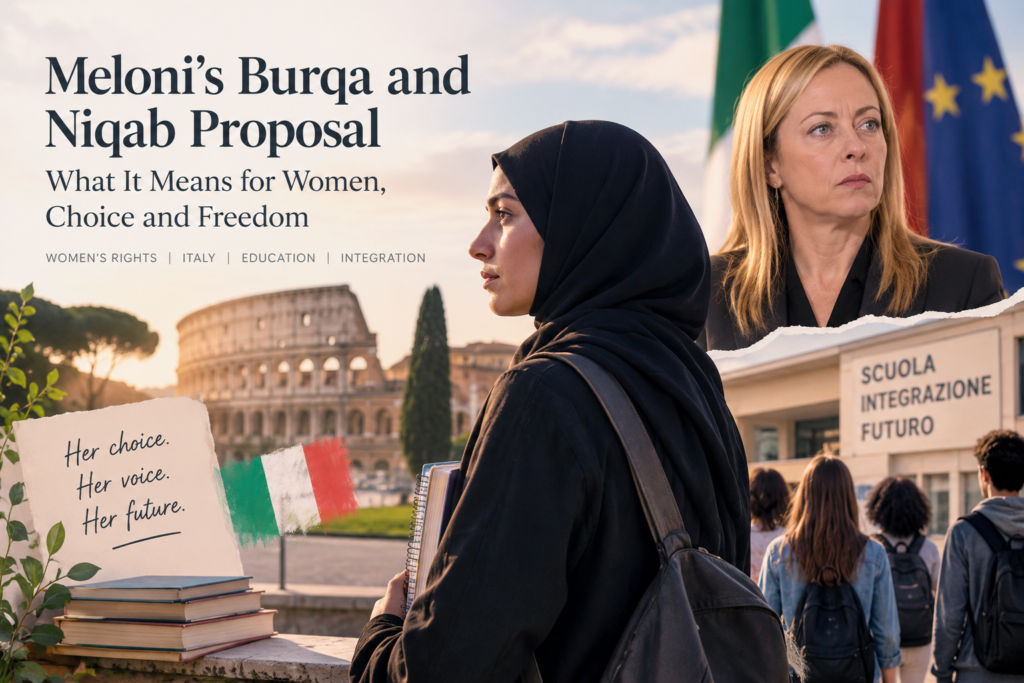
A woman’s clothing can say many things. It can reflect faith, culture, identity, family, personal taste—or simply a decision that does not need explaining to anyone else.
That is what makes Italy’s latest Meloni burqa niqab ban proposal so complicated. Prime Minister Giorgia Meloni has announced plans to prohibit burqas and niqabs in schools, alongside a proposed limit on the number of foreign students in individual classrooms. The government also plans to require Italian-language lessons for some parents of foreign students facing serious integration difficulties. The proposals were announced on September 20 and still have to go through the legislative process.
But beneath the headlines about immigration, integration and religious clothing sits a much more personal question: when we talk about protecting women, are we also listening to what women themselves want?
That question takes the debate far beyond a discussion about a piece of clothing. It brings us to the heart of women’s rights in Italy—and to a difficult conversation about choice, autonomy, faith and who gets to decide what freedom should look like for a woman.
What Exactly Is Italy Proposing?
Meloni’s government plans to introduce legislation that would prohibit full-face coverings, specifically burqas and niqabs, in schools. The proposal would also establish a maximum number of foreign students per classroom, although Meloni has not announced the exact number. Some parents of foreign students experiencing serious integration problems could also be required to learn Italian.
There is an important distinction here.
A burqa covers the body and face, while a niqab covers the face but generally leaves the eyes visible. A hijab is different: it covers the hair and neck while leaving the face uncovered. The proposal concerns full-face coverings, not a general ban on the hijab.
Meloni has presented the measures as part of a broader effort to strengthen integration in Italian schools.
Her argument is that schools need a common language and environment in which children can participate fully.
But when the subject is women’s clothing, the conversation becomes much more sensitive.
The Feminist Question Nobody Can Avoid
There is an uncomfortable contradiction at the center of this debate.
Feminism has spent decades arguing that women should have control over their own bodies and lives. That includes the right to decide how they dress.
But what happens when a woman says her religious clothing is her choice?
What happens when another woman says someone pressured her into wearing it?
Both realities can exist.
A woman can experience a religious garment as an expression of faith and identity. Another woman may experience pressure from family or community expectations. Treating either experience as universal risks erasing the woman behind the argument.
That is why the burqa and niqab ban raises a question that goes deeper than whether face coverings are acceptable or unacceptable.
It asks who gets to make the decision.
Protection and Choice Are Not the Same Thing
Protecting women from coercion is a legitimate concern.
If a person forces a girl to cover her face against her wishes, her freedom matters. Individuals blocking her from attending school, taking part in public life, or deciding her own affairs deserve attention.
But there is another side to the conversation.
If a woman freely chooses to wear a niqab because it is part of how she understands her faith, removing that choice through law raises a different question about women’s autonomy.
A feminist approach cannot simply replace one form of control with another.
The principle should be bigger than the garment itself: women should have meaningful control over their own choices.
That is much harder than telling women what they should or should not wear.
Why Religious Freedom Matters Too
The proposal inevitably touches religious freedom, particularly for Muslim women who choose to wear religious clothing.
This does not mean every religious practice is automatically beyond government regulation. Governments can impose rules in schools and public institutions for legitimate reasons, including identification and safety.
But those restrictions still deserve careful examination.
The important question is whether a particular restriction is necessary, proportionate and applied fairly—and whether the people affected by it have actually been heard.
Across Europe, governments have taken different approaches to face coverings. France has a nationwide restriction on concealing the face in public, while countries including Belgium, Denmark, Austria and Switzerland have introduced their own restrictions with different scopes.
Italy’s proposal therefore enters an existing European debate. But that does not make the personal question any less important.
What Does This Mean for Muslim Women?
For Muslim women in Europe, conversations about veils can become frustratingly one-dimensional.
They are often discussed as symbols of immigration, religious conservatism or cultural conflict.
But a woman wearing a veil is not a symbol before she is a person.
She may be a student worrying about an exam. A mother taking her child to school. A professional going to work. Someone deeply religious. Someone negotiating family expectations. Or simply someone who does not want strangers debating her appearance.
There is no single story that explains every Muslim woman.
And that matters when governments create policies that directly affect them.
If feminism means taking women’s experiences seriously, then those women cannot be left out of the conversation about their own lives.
The Foreign-Student Question Adds Another Layer
The face-covering proposal comes alongside a separate plan to limit the number of foreign students in individual classrooms.
According to figures from Fondazione ISMU cited by Reuters, students who are not Italian citizens account for around 11.6% of pupils enrolled in Italian schools. Meloni has argued that when too many students in one class struggle with Italian, integration can become more difficult.
The government has not yet specified the proposed classroom cap.
That detail matters because there is a difference between helping children integrate and simply separating them.
Language support, additional teachers and stronger resources can help students participate in school without making nationality the dividing line.
The question is not only how many foreign students should be in one classroom.
It is also what schools are being given to help every student succeed.
Can Integration Happen Without Erasing Identity?
This may be the most interesting question in the entire debate.
Integration does not necessarily mean becoming identical.
A child can learn Italian, understand Italian institutions, participate in school life and still maintain a family language, religion or cultural identity.
In fact, schools are often where different identities first meet.
That can be difficult. It can also be valuable.
The challenge for any education system is finding a way to create a shared environment without making minority students feel that participation requires abandoning everything that makes them different.
A Feminist Debate Should Leave Room for Women to Disagree
One of the easiest mistakes in debates about women’s rights is assuming that there is one universally correct female experience.
There isn’t.
Some women may see restrictions on face coverings as protection from patriarchal pressure.
Others may see those same restrictions as government interference in personal and religious choice.
Both perspectives deserve to be discussed without pretending that women form one perfectly unified group.
The feminist principle worth holding onto is not that every woman must make the same choice.
It is that women should have the ability to make meaningful choices about their own lives.
So, Who Gets to Decide?
That is ultimately the question Italy’s proposal puts on the table.
If the state says a woman must uncover her face, the state is making a decision about her body.
If a family says a woman must cover her face, the family is making a decision about her body.
Neither situation automatically tells us what the woman herself wants.
That is why the conversation needs to move beyond the simple question of whether the burqa or niqab is “good” or “bad.”
The harder—and more important—question is whether the woman wearing it has a genuine choice.
What Happens Next?
The measures announced by Meloni are proposals rather than an enacted nationwide school ban. The government is expected to take the proposed legislation forward, after which the details and parliamentary process will determine what actually becomes law.
That means the debate is far from finished.
The final details will matter: how the rules are written, who they apply to, how exceptions are handled and how schools are expected to enforce them.
Most importantly, the voices of the women and students affected by the policy should remain part of that discussion.
Conclusion
Meloni’s proposed burqa and niqab ban is being presented as a question of integration, education and freedom. But it also opens a deeply personal conversation about women, religion and control over one’s own body.
There is no need to romanticize forced religious clothing. But there is also no need to assume that every woman wearing it is powerless.
Real feminism should be able to hold both ideas at once.
It should challenge coercion wherever it comes from—inside the family, within a community or through institutions—while protecting a woman’s ability to make decisions for herself.
Because ultimately, women’s rights in Italy, as anywhere else, cannot simply be about deciding what women should wear.
They have to be about giving women the freedom, safety and dignity to decide for themselves.

Pingback: Ethiopia and Tigray Conflict: New Offensives Raise Fears of Another War - blogs.digitalgrowth.media