

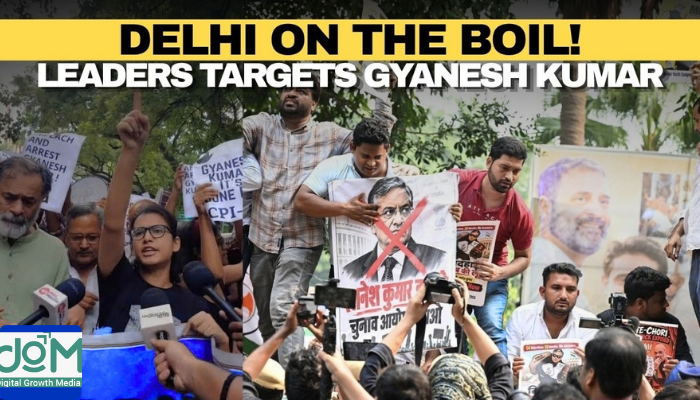
As India prepares to observe Gandhi Jayanti on October 2, 2026, planned protests concerning Chief Election Commissioner Gyanesh Kumar have brought Jantar Mantar in Delhi and Shivaji Park in Mumbai into the national news cycle.
The demonstrations are connected to disagreements over the functioning of the Election Commission of India (ECI), particularly the Special Intensive Revision (SIR) of electoral rolls. Different political and civil-society groups have raised concerns about the exercise, while the Election Commission has defended its decisions and said key SIR decisions were taken with the unanimous approval of its three commissioners.
Gyanesh Kumar has served as Chief Election Commissioner since February 19, 2025. The ECI identifies him as the 26th CEC of India.
Why Are Protests Planned on Gandhi Jayanti?
The timing of the demonstrations is significant because October 2 marks Gandhi Jayanti, the birth anniversary of Mahatma Gandhi. The day is associated with Gandhi’s philosophy of non-violence and peaceful civic action.
The current protests, however, are driven by contemporary disagreements surrounding electoral roll revision, the Election Commission and demands concerning the CEC.
Several groups have announced demonstrations or wider protest programmes. Among the issues raised by organisers are concerns about the SIR voter list revision, alleged irregularities in electoral processes and demands for greater transparency.
It is important to distinguish these allegations from established findings. The Election Commission has rejected suggestions of internal disagreement over recent SIR decisions and stated that decisions were unanimously approved by the full commission.
What Is Planned at Jantar Mantar?
Delhi’s Jantar Mantar has been identified as one of the focal points for the October 2 demonstrations.
A protest was announced by the All India Students’ Association, Rajya Sabha MP Manoj Jha and Supreme Court lawyer Prashant Bhushan. Organisers have called for action concerning the Chief Election Commissioner and have raised objections relating to electoral-roll revision.
However, the status of the gathering has changed as authorities have responded to the proposed event.
On October 1, Delhi Police refused permission for the proposed Jantar Mantar protest, according to reports, and security arrangements were strengthened around the area. Police sources estimated that approximately 3,000–4,000 people could potentially turn up, prompting additional security deployment.
This means people following the Gandhi Jayanti protests should check the latest official announcements before travelling to Jantar Mantar, as the originally announced programme may not proceed in its proposed form.
What Is Happening at Shivaji Park in Mumbai?
Mumbai is another major location connected with the October 2 protest campaign.
The Cockroach Janta Party (CJP), led by founder Abhijeet Dipke, announced a demonstration at Shivaji Park demanding the resignation of Gyanesh Kumar. The organisation has also raised demands relating to electoral rolls and the appointment process for election commissioners.
Mumbai Police, however, denied permission for the proposed gathering at Shivaji Park. Reports said the police advised organisers to consider an alternative venue under applicable rules.
Following the denial, the organisers announced plans for a Jail Bharo Andolan, or civil-disobedience-style protest, rather than proceeding with the originally proposed gathering at the park.
For readers tracking the Shivaji Park protest, this distinction matters: the announced protest plan and an officially permitted public gathering are not necessarily the same thing.
What Is the Special Intensive Revision of Electoral Rolls?
The Special Intensive Revision (SIR) is at the centre of much of the current political disagreement.
Electoral-roll revision involves reviewing voter lists to ensure that eligible electors are appropriately included and that electoral records are updated. The current dispute concerns how the revision is being conducted and its potential impact on voters.
Opposition parties and civil-society groups have raised concerns about the process and its implications for voters. The Election Commission, meanwhile, has announced changes to aspects of the SIR process.
On September 26, the Commission said voters receiving notices over certain issues, including being “unmapped” or having logical discrepancies, would not necessarily have to appear personally before an Electoral Registration Officer. It also extended certain deadlines in Delhi and Maharashtra.
For anyone trying to understand the wider Gyanesh Kumar controversy, following the actual electoral-roll decisions is more useful than relying only on protest slogans or social-media posts.
What Should Readers Watch on October 2?
The situation is fluid, so several developments could change during Gandhi Jayanti 2026.
1. Changes to protest locations
Since police permission has been denied for the proposed gatherings at both Jantar Mantar and Shivaji Park, organisers may change locations or formats.
2. Security arrangements
Delhi authorities have increased security around Jantar Mantar and other parts of New Delhi in anticipation of possible gatherings.
3. Statements from the Election Commission
The ECI’s response will remain an important part of the story because the protests are closely connected to the SIR process and questions about electoral administration.
4. Further demonstrations
The October 2 events are part of a wider series of demonstrations rather than an isolated incident. Reports indicate that different political and civil-society groups have planned activities concerning the Election Commission and electoral-roll revision.
Why This Story Matters Beyond Delhi and Mumbai
The significance of the protests extends beyond the two cities because electoral rolls affect voters across India.
For readers, the most useful way to follow the issue is to separate three things: what organisers are demanding, what authorities have officially decided, and what has actually happened on the ground.
This approach is particularly important during rapidly developing political stories, where early reports and social-media claims can change as authorities issue new statements.
Readers looking for more current explainers and developing stories can also explore the latest updates published on Digital Growth Media Blogs.
Conclusion
The planned Gandhi Jayanti protests involving Jantar Mantar and Shivaji Park have become part of a wider dispute over the Election Commission, electoral-roll revision and demands concerning Chief Election Commissioner Gyanesh Kumar.
As of October 1, Delhi Police had refused permission for the proposed Jantar Mantar gathering, while Mumbai Police had earlier denied permission for the planned Shivaji Park event. Organisers have indicated alternative forms of protest, making the situation subject to further developments.

Pingback: Drishyam 3 Box Office Collection Ajay Devgn's Biggest Opener