The digital search landscape is undergoing a significant shift. The introduction of the AI search engine for businesses is changing the way individuals find information, engage with content, and make purchases through the internet. Traditional search approaches are being supplemented by conversational search systems that provide answers to questions rather than long lists of links.
As a result, businesses, marketers, publishers, and website owners are paying close attention to the steady growth of the AI search engine market. As a result of this shift, consumer behaviors are changing, as are expectations of the user experience; therefore, content strategies must also be revised to maintain visibility during this transition.
Each time a technological advancement occurs, search platforms become more intelligent. Additionally, artificial intelligence is beginning to influence how information is collected, analyzed, and presented to the end user. Moreover, businesses are now re-evaluating their content strategies based on the evolution of consumer search patterns. As a result, website visibility is dependent upon the relevance to the user as well as the expertise and contextual value of the information. As the proliferation of the AI search engine continues to expand, so does the amount of opportunity and challenge presented to the digital marketplace.
The Rising Trend of Search Engines Using AI
Nowadays, many of the current-day AI-powered search engine platforms utilize NLP, AI, and ML as the means by which they wish to not just know what you want but also to provide contextual content by understanding your intent. Not only can these search engines understand what the user is asking, but they can also provide you with accurate, ready-to-convert answers.
The following are the main characteristics of the new AI search engine model:
- Conversational-based interaction
- Personalized responses
- Context-aware answers
- Summarized information delivery
- Faster Time to Information
The reason why many people now use AI search engine platforms is that they want the fastest possible time to find accurate answers without having to go through many different websites.
Google Search As A Historical Benchmark
For decades now, Google has been the market leader within the search engine industry, as it relies on crawling, indexing, and producing a list of results of web pages based on relevancy and authority.
The following are the strengths of Google Search:
- Enormous Web Index
- Established Page Ranking Algorithms
- Strong Localized Search Engine Capabilities
- Enormous Website Discovery Capabilities
- Mechanical source diversity
On any given day, millions of websites get traffic from Google Search. The only way a website earns its rankings is through the efforts of SEO, content quality, backlinks, and user experience.
How is an AI search engine different?
The primary distinction is in how information is presented.
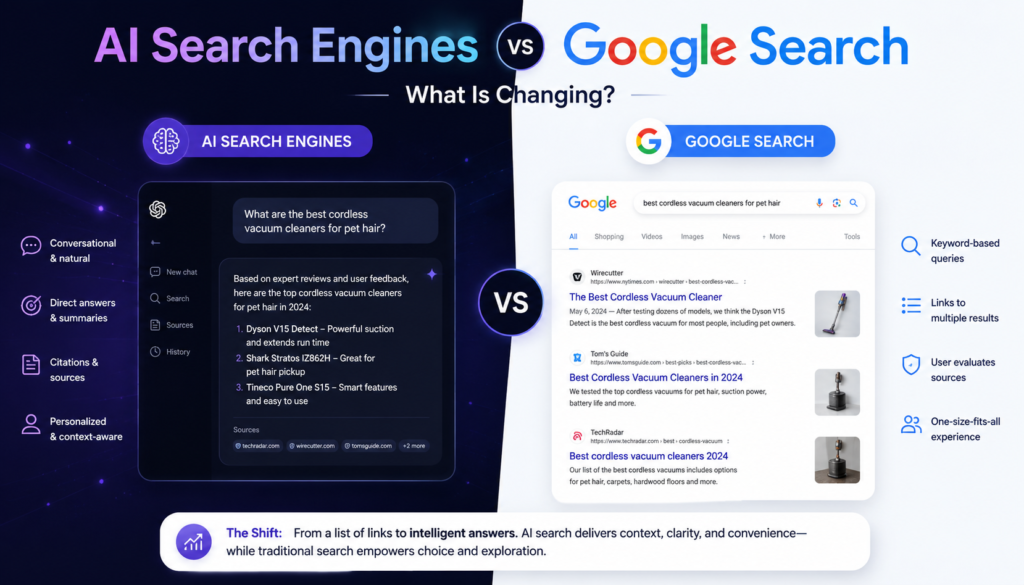
With Google, there will generally be a list of results. Conversely, an AI search engine will provide a direct answer to your question.
Some of the main differences are the following:
Answers Provided Directly
The responses provided will be concise summaries.
Conversational Searching
The questions can be rephrased more naturally.
Retention of Context
The search engine retains prior searches as part of the ongoing conversation.
Authority of Intent
A more sophisticated request can be interpreted more accurately.
Less Searching Activity
Many searches can be conducted through one interaction.
The above-mentioned capacities have created increased interest in AI search engine technologies across many different industries.
Changing User Behavior in the Search Process
Recent observations of changing user behavior in the market have shown that more and more people are searching for convenience. Users want answers now. Researching for a long period is becoming rare.
Some general trends in browsing behavior include:
- Searching by voice
- Conversational phraseology of queries
- Multiple queries are being posed sequentially within one search
- Requests for personalization
- A tendency to search using mobile devices first
An AI search engine provides a more natural way for users to perform these types of searches compared with using a more traditional keyword-driven search engine.
Effect on SEO Strategies
There have been big changes in the world of SEO.
Keyword optimization is still required
Today, the importance of high-quality content has grown in importance.
To have a successful website during this new era of search engines, it is vital for you to create the following:
High-Quality Authoritativeness
By creating authoritativeness through providing expert insight, it will help to build more trust.
Providing Answers to REAL Questions
Clearly identify your customer’s intent and provide a clear answer to their need.
Creating a Logical and Organized Content Structure
Using headings and logic will help AI systems to understand the content on your site.
Educating Your Visitors in Your Area of Expertise
By showing that you have knowledge of your industry (your area of expertise), you will develop more credibility.
Establishing Brand Authority
You will gain more visibility if you are a well-known brand.
While the new AI search engine will change the way websites are developed, having a well-optimized website to be successful is still required.
The benefits you get from AI search engines
There are a few advantages, really driving this whole adoption thing.
Faster research
Stuff can get collected quickly, in a smoother way than before
Better user experience
Natural chats feel more intuitive, and less like you are just typing keywords
Simplified decision-making
With summarized insights, the whole process takes less effort
Improved accessibility
Even complicated topics become easier to grasp, not just for experts, but for regular users too
Personalized results
More relevant answers show up, often generated in a way that matches what you were actually looking for
These strong points keep pushing growth inside the AI search engine sector.
Challenges Facing AI Search Engines
Even with all the fast growth, there are still some limits that show up pretty quickly.
A lot of common worries pop up, like maybe the system can be wrong on facts, or it does not clearly show where the info came from. There’s also the matter of limited website exploration, which can reduce referral traffic, and then there’s the whole dependence on whatever training data it was built with.
For publishers, the real question is basically how the expansion of an AI search engine might change content visibility and audience engagement in practice, not just in theory.
What This Means for Businesses
Right now, companies can’t just lean on classic SEO tactics like it’s the only lever. Instead, a more inclusive content plan feels necessary, not optional.
In general, recommended actions are along these lines:
– Publish high-quality content on a regular basis
– Strengthen brand authority
– Build topical expertise, more than just “coverage.”
– Improve user experience, like page speed and clarity
– Create question-focused content that actually matches how people ask things
Organizations that adjust early may see better visibility across both Google Search and AI search engine platforms.
The Future of Search
Search tech keeps moving, kind of aggressively, and industry experts are expecting a hybrid setup where traditional search engines and AI-driven systems sort of coexist.
Looking ahead, some possible changes include:
– More personalized search experiences
– Stronger conversational functionality, more back and forth
– Enhanced multimodal search, mixing text, images, and more
– Better source attribution so people can verify
– Improved answer accuracy over time
Overall, the influence of the AI search engine will likely keep expanding as user expectations keep shifting and as people decide what “good answers” should look like.
Also Read: AI Tools Every Digital Marketer Should Use
FAQs
1. What is an AI Search Engine?
Answer: So an AI search engine uses artificial intelligence to… kinda grasp what the user means, and then it can produce direct context-aware responses instead of only showing website links.
2. Will AI search engines replace Google Search?
Answer: A total replacement seems unlikely soon. Most likely, the two will sit together for a while, serving different wants and different browsing habits.
3. How does an AI search engine affect SEO?
Answer: SEO stays relevant, no doubt. But the emphasis is shifting, because content quality, demonstrated expertise, authority signals, and information that actually helps people are getting more and more weight over time.
4. Why are users adopting AI search engines?
Answer: People like faster results, a chatty back-and-forth feel, and more personalized info that matches what they’re looking for in a practical way.
5. Should businesses optimize for AI search engines?
Answer: Yes, absolutely. Businesses should publish strong content that answers questions clearly and also shows real know-how. That helps with visibility across the changing search platforms, not just one.