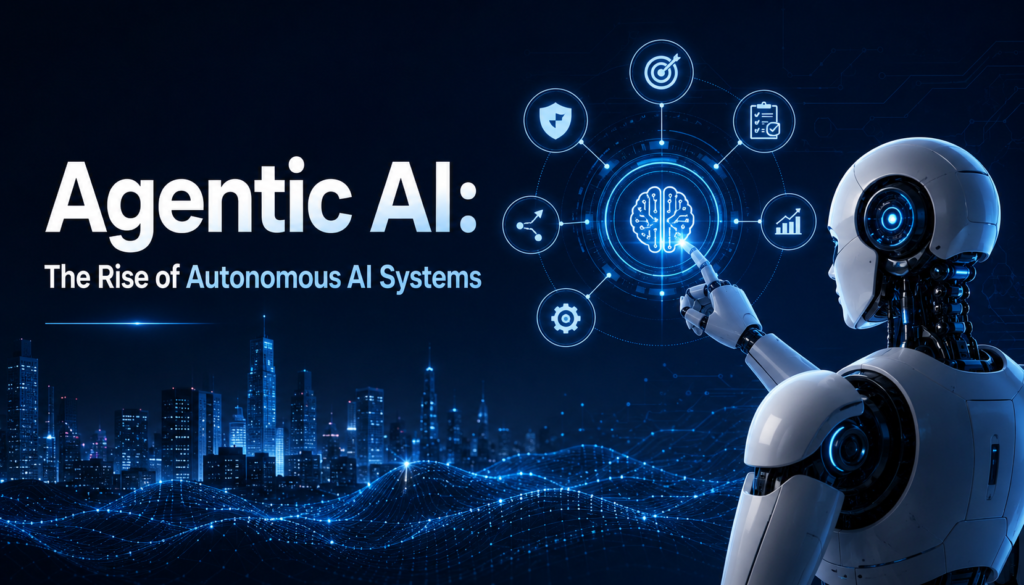
Automation and decision-making will experience changes owing to advances in Agentic AI technology. Currently, the technology no longer focuses on chatbots or recommendation engines alone but has advanced to build systems capable of thinking, planning, executing tasks, and improving workflow efficiency without requiring much human interaction. These developments have led smart agentic AI to become one of the central subjects of discussion among enterprises looking for technologies. According to current reports, it has become clear that autonomous systems have moved from being experimented with to their production-level deployment in various industries, including healthcare, finance, logistics, software development, and customer service.
There is no longer a need for organizations to assess the usefulness of autonomous AI systems. Instead, the question has become how fast such systems can be rolled out while still maintaining governance.
Definition of Agentic AI
Powerful Agentic AI is a type of artificial intelligence technology that operates independently in pursuit of set goals. These AI systems have the ability to:
- Analyze data on its own
- Take decisions based on situational understanding
- Carry out tasks on its own
- Learn from results
- Reorient its strategy in response
All of this helps to create a system that works similarly to a virtual team rather than an ordinary software application.
An example of the operations of such an AI tool in a customer support department would be to:
- Detect customer support queries
- Categorize their importance
- Prepare customized responses
- Forward critical situations
- Learn from prior encounters
Next-generation Agentic AI technology is thus extremely useful for business organizations.
Why Agentic AI is Gaining Popularity So Quickly
There is an increasing demand for autonomous systems owing to certain market requirements.
Refinement of Planning Models
Planning models used by large language models have grown increasingly accurate. They help the agents to execute multistep tasks consistently.
Need for Enterprise Automation
Enterprises look for solutions that eliminate tedious and repetitive manual efforts while increasing speed.
Cost Efficiency
There is immense pressure on enterprises to achieve greater efficiencies. Autonomous systems decrease dependence on big operational teams.
Infrastructural Maturity
Cloud infrastructure, orchestration, and AI governance systems have matured enough to support large-scale deployments.
Distinctive Features of Autonomous AI
Today’s top agentic AI systems come with features that set them apart from their predecessors.
Purposeful Decision Making
These systems pursue certain objectives and not merely react to orders.
Multistep Task Completion
They are capable of breaking up goals into small steps.
Some examples include:
- Automation of market research
- Management of sales pipelines
- Processes involved in fraud detection
- Automation of content creation
Continuous Adaptation
These systems modify their actions through the implementation of feedback mechanisms.
Tool Integration
The systems work alongside APIs, databases, CRM platforms, web browsers, and other enterprise tools.
The extent of integration is making various business implementations possible.
Sectors Utilizing Agentic AI
There are some industries that have been adopting the technology rapidly.
Healthcare
The future of agentic AI is used for the following:
- Patient appointment scheduling
- Medical documentation
- Diagnosis support
- Resource management
Hospitals and other healthcare institutions are using the latest agentic AI to cut down on administration.
Finance
Autonomous systems help organizations perform tasks such as the following:
- Risk assessment
- Fraud detection
- Compliance checking
- Portfolio management
Recent research shows an increase in the use of smart agentic AI in financial intelligence systems.
Software Development
There are autonomous AI systems being utilized in:
- Code creation
- Detecting bugs
- Testing code
- Monitoring deployment
- Logistics & Supply Chain
The agentic systems help with:
- Route optimization
- Supply chain management
- Demand forecasting
- Scheduling deliveries
Obstacles Faced by Agentic AI
Although there is rapid growth, many challenges need to be overcome.
Governance Issues
With autonomy comes a risk to the organization’s governance.
Lack of proper measures may lead to:
- Non-compliance
- Security risks
- Malpractice
Issues With Reliability
AI agents can make mistakes in challenging environments.
Costs of Scaling
Scalable implementation requires substantial infrastructure investment.
Issues of Ethics
Questions related to accountability still exist.
Current Market Developments for 2026
The next-generation Agentic AI market across the globe is developing rapidly.
The major findings include:
- Moving from experiments to real-world implementation
- Emergence of platforms for orchestrating agent activity
- Development of oversight strategies for human collaboration
- Introduction of specialized agents for individual domains
According to predictions, over 60% of companies are getting ready to implement agents’ solutions in their operations within two years.
It shows both enthusiasm and reluctance on the part of organizations.
The Future of Agentic AI Technology
The future belongs to collaborative intelligence. People will cooperate more with autonomous systems.
Expected advancements include:
- Building multi-agent environments
- Improvement of self-learning skills
- Implementation of explainable AI techniques
- Establishing regulatory mechanisms
- Development of sector-specific autonomous solutions
The role of agentic AI technologies will transform the way companies operate fundamentally. Companies making early investments will acquire a competitive edge.
Reasons for Companies to Care
Companies that understand top Agentic AI now will be well-prepared for the future of competition.
They will enjoy:
- Greater efficiency
- More accurate decision-making
- Lower costs
- Scalability
- Better customer experiences
Failure to recognize this trend may result in an unfavorable future for organizations.
Also Read: How to Use AI Tools For Content Writing: A Complete Guide
FAQs
1. Why is Agentic AI unique compared to generative AI?
Answer: Generative AI generates content using prompt-based instructions. Agentic AI is able to plan, act, and execute operations autonomously.
2. Is Agentic AI safe to use in business settings?
Answer: Agentic AI can be safe for use when applied within the right governance and controls.
3. What industries are most adopting Agentic AI?
Answer: Agentic AI is seeing the greatest adoption in finance, healthcare, logistics, customer support, and software development.
4. Will Agentic AI take away jobs from humans?
Answer: Agentic AI will not take away jobs but will instead transform the way work gets done through automation.
5. How costly is Agentic AI implementation?
Answer: It depends on scale, among other factors, but implementations are becoming less costly and easier than before.