
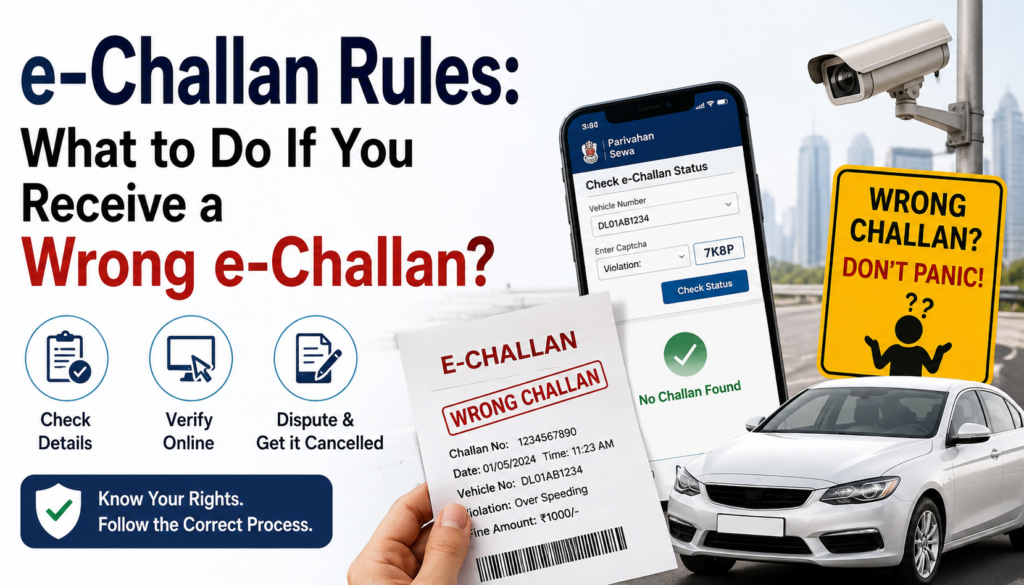
Getting an e-Challan for a traffic violation you never even did can be really confusing and honestly kind of annoying. As CCTV cameras keep getting more common, AI-powered surveillance too, plus automated traffic enforcement systems in the picture, small errors can still occur sometimes. The good part is that the e-Challan Rules set out a kind of process so vehicle owners can dispute, and request cancellation for a challan that was issued by mistake.
In this guide, you’ll find out everything about e-Challan Rules, like why the wrong e-Challans sometimes get generated, how to verify them properly and the step by step online procedure to ask for cancellation, without missing anything.
What Are e-Challan Rules?
e-Challan Rules are basically part of Indias digital traffic enforcement arrangement, introduced under the Motor Vehicles Act. Rather than handing out paper challans, traffic authorities usually create electronic challans, with CCTV cameras plus speed detection devices, Automatic Number Plate Recognition (ANPR), and even handheld gadgets.
In this setup the traffic police can log violations digitally and then push the fine straight to the registered vehicle owner, via SMS or through online portals, sometimes it depends on the region.
The main goals of e-Challan Rules look like this, overall improving road safety, reducing the manual paperwork load, boosting transparency. It also helps with online payment of traffic fines, and keeps dependable digital records of traffic violations in place
Why Can a Wrong e-Challan Be Issued?
Even if the e-Challan system is really efficient, it is still not 100 percent error-free. In day to day usage, a bunch of things can cause the challan to come out wrong, kinda weirdly.
1. Wrong number plate capture
Sometimes the traffic cameras end up misreading number plates because of harsh lighting, a damaged plate, or a blurred image.
2. Mistakes from people
At times, the traffic officials can accidentally type a wrong vehicle registration number when the challan is being issued.
3. Tech troubles
Software problems, or a mismatch in system syncing can occasionally end up creating the wrong traffic violation entries.
4. Close or similar registration details
If two vehicles have very similar registration numbers, there is a chance the wrong person becomes the “target” for the e-Challan.
5. Ownership status not updated
If you sold your vehicle but the ownership transfer was not updated in the records, then the challan might still show up on your name.
How to Verify an e-Challan?
Before you go ahead and file a complaint, try to carefully recheck every item that’s written in the challan, like don’t just skim it.
Make sure you look at these things, properly : vehicle registration number, date and time of the violation, the exact incident spot, the kind of traffic violation, the stated fine amount, and also whether there is CCTV image or video proof available.
If even one of these details turns out to be wrong, you still have the right to dispute the challan as per the e-Challan Rules.
Signs That Your e-Challan Is Incorrect
You should raise a complaint if:
- Your vehicle was somewhere else at the time of the violation.
- The vehicle shown in the image is not yours.
- The registration number has been entered incorrectly.
- The violation occurred in a city you never visited.
- You had already sold the vehicle before the challan was issued.
- The CCTV evidence does not match your vehicle.
How to Cancel a Wrong e-Challan Online?
Follow these steps if you believe your challan has been issued incorrectly.
Step 1: Visit the Official e-Challan Portal
Go to the official e-Challan website or your state’s Traffic Police portal.
Step 2: Search Your Challan
Enter any one of the following:
- Vehicle Registration Number
- Challan Number
- Driving Licence Number
Click on Get Details to view your challan.
Step 3: Check the Evidence
Review the complete details carefully.
Look for:
- CCTV images
- Vehicle number
- Date and time
- Location
- Type of violation
If the information is incorrect, proceed with filing a dispute.
Step 4: Raise a Complaint
Most traffic portals provide options like:
- Raise a Grievance
- Dispute Challan
- Submit Representation
- Report Wrong Challan
Select the appropriate option.
Step 5: Upload Supporting Documents
Attach documents that support your claim.
These may include:
- Registration Certificate (RC)
- Driving Licence
- Aadhaar Card or other identity proof
- Sale agreement (if the vehicle has been sold)
- GPS location history
- Parking receipts
- Dashcam footage
- Photographs of your vehicle
The stronger your evidence, the better your chances of getting the challan cancelled.
Step 6: Explain the Issue Clearly
Write a detailed explanation mentioning why you believe the challan is incorrect.
For example:
- Wrong vehicle identified
- Incorrect registration number
- Vehicle sold before the incident
- Vehicle was parked elsewhere
- CCTV image does not match your vehicle
Keep your explanation factual and concise.
Step 7: Submit Your Request
After submitting your complaint, you’ll receive a complaint number or reference ID.
Save it carefully so you can track your complaint later.
What Happens After You File a Complaint?
Once your grievance is submitted, the traffic department will investigate your request.
The authorities may:
- Review CCTV footage
- Verify your vehicle registration details
- Examine the uploaded documents
- Contact you if more information is required
If the investigation confirms that the challan was issued incorrectly, it will be cancelled.
If the violation is found to be genuine, you will need to pay the applicable fine.
Documents Required to Dispute an e-Challan
Keep these documents ready before raising your complaint:
- Vehicle Registration Certificate (RC)
- Driving Licence
- Aadhaar Card or other government-issued ID
- Vehicle Insurance
- Pollution Under Control (PUC) Certificate
- Sale agreement (if applicable)
- Travel records
- GPS history
- Dashcam footage
- Vehicle photographs
Tips to Avoid Receiving Wrong e-Challans
You can reduce the chances of receiving an incorrect challan by following these simple tips:
- Keep your vehicle registration details updated.
- Complete ownership transfer immediately after selling your vehicle.
- Ensure your number plate follows government standards.
- Avoid damaged or fancy number plates.
- Regularly check your e-Challan status online.
- Update your registered mobile number with the RTO.
Following these simple practices will help you stay compliant with e-Challan Rules.
Can You Ignore a Wrong e-Challan?
No.
Even if you believe the challan has been issued incorrectly, do not ignore it.
Instead:
- Verify the details.
- Gather supporting evidence.
- Raise a dispute immediately.
Ignoring an e-Challan can lead to additional penalties, legal notices, or complications during vehicle-related services.
Conclusion
India’s digital traffic enforcement system has, somehow made road violations monitoring faster, and also more transparent. Yet automated setups are not completely perfect ,they sometimes slip into occasional errors. Knowing the e-Challan Rules helps vehicle owners spot those mistakes, dispute wrong charges, and save themselves from unnecessary penalties.
If you ever end up with a wrong e-Challan ,try not to panic. First, double-check every detail ,then gather supporting evidence, and file your grievance via the official portal as early as you can. Moving quickly, will boost the chances of a favorable resolution and keep your driving record properly aligned.
So, by staying clued up on e-Challan Rules, you can tackle an incorrect challan with confidence, while still following traffic regulations, and encouraging safer roads for all of us.