
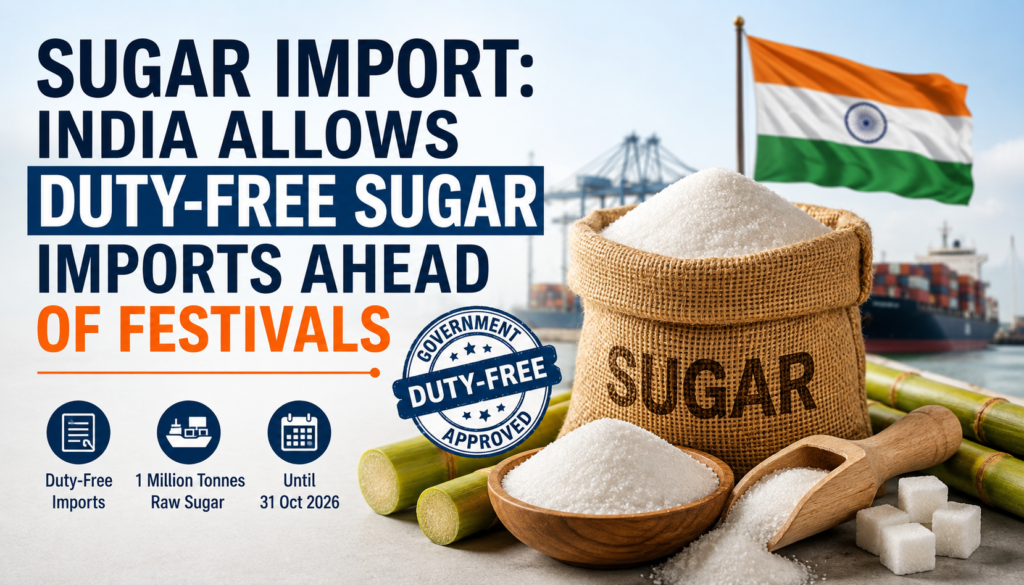
The government has taken a big step to rein in the surging sugar prices ahead of the festive season, basically. The Directorate General of Foreign Trade (DGFT) has said that 1 million metric tonnes of raw sugar can be brought into India without paying import duty, up to October 31, 2026, and that’s it.
This announcement comes when local sugar prices have been climbing, not fast but steadily. Retail sugar prices were around ₹48–₹50 per kg in early August, whereas wholesale prices were moving at roughly ₹4,750–₹4,800 per quintal.
Now, under this Sugar Import policy, the duty-free benefit will be routed via the Tariff Rate Quota (TRQ) system. So the exemption is for that exact band of 1 million metric tonnes only, no more. After the quota gets used up , the existing import duty setup will kick in again.
Government Opens Duty-Free Sugar Import Window
Earlier, the sugar import policy was basically placed under “Free” , but there was no extra condition really attached to it. Now the newest notification keeps it in the “Free” bucket, though it also adds a temporary rider, that permits duty-free imports of as much as 1 million metric tonnes of raw sugar, till October 31, 2026.
This call seems to be made to boost domestic availability of sugar, and also to stop prices from climbing much more ahead of the festive stretch.
Festivals like Ganesh Chaturthi, Dussehra and Diwali tend to push up sugar demand, because people buy more sweets, packaged, processed foods, and a bunch of other items during that time.
One-Time Option for Advance Authorisation Holders
Companies that already have an Advance Authorisation can now get a one time option to shift their authorisation from the Advance Authorisation Scheme to the TRQ scheme, basically.
But this option is only for the quantity of raw sugar that has actually been imported, as of the date of the notification. It will also extend to refined sugar that has already been produced, or will be produced from that imported raw sugar, somehow.
The switch is not going to be fully tax free. Firms opting for the change will have to pay the GST from which they had gotten an exemption at the time of import, yes.
One more key condition is that the refined sugar made from the imported raw sugar needs to be sold in the domestic market by October 31, 2026.
Earlier, port based refineries were permitted to import duty free raw sugar on the condition that the equivalent quantity of refined sugar would be exported. The latest step suggests the government now wants this sugar to land in the domestic market instead, so it can help boost supply and ease price pressure.
DGFT Yet to Announce Detailed TRQ Process
The DGFT is expected to issue a different public notice, explaining how the TRQ system will be rolled out, basically.
In the same way, the detailed guidelines are expected to shed light on who will be allowed to import sugar, and how exactly, the 1 million-tonne quota will be divided, between eligible players.
They should also mention the application timelines . Further, it should specify the quantity any individual mill or company can actually bring in, and what other conditions would need to be met to access the duty-free quota.
Until those details are finally announced, a few points of the Sugar Import process will stay a bit unclear, for now.
Sugar Prices Rise Sharply in Maharashtra
Sugar prices have also seen a fairly notable upturn in several key producing areas. In Kolhapur, the wholesale rate for sugar has gone up by almost 20% since the start of August, landing at a record level of about ₹5,350 per quintal.
India is actually the world’s second-largest sugar producer, and at the same time the biggest sugar consumer. If those planned imports do end up happening, it could end up being the country’s first meaningful sugar import in roughly a decade.
So the government is trying to expand supply, basically at the same time when domestic prices are getting squeezed or kept under pressure.
Why Are Sugar Prices Rising?
A number of things, have been sort of behind the recent rise in sugar prices, and it feels like a chain reaction in different directions.
1. Less Rain in Key Growing Areas
Maharashtra and Karnataka sit among India’s biggest sugar-producing regions. But in some parts the rainfall has dropped, and that has put some anxiety on sugarcane output for the coming season.
If sugarcane supply were to fall , even a bit, it could lower overall sugar production and then, naturally, add more pressure to prices.
2. Ethanol Demand keeps Growing
Then there’s the government ethanol blending programme.
In practice a part of sugarcane and sugar output gets redirected, into ethanol production. Sure, this supports India’s cleaner energy targets… but it can also pull back the sugar that would otherwise be available for the domestic market.
Reports say the government is thinking about steps to raise sugar availability for the upcoming season. This includes checking how much sugarcane can be used for ethanol, and related allocation decisions.
3. Festive demand, is also a big deal
The festival period is another main reason why people are worried about sugar prices.
With Ganesh Chaturthi, Dussehra and Diwali coming closer, consumption of sweets, bakery items, processed foods , and household sugar is expected to rise.
The government, wants to avoid a situation where retail sugar prices jump sharply just because the season is busy.
4. Exports were already being tightened
This latest sugar import move is not the first attempt by the government to steady prices at home.
On May 13, 2026 , the government shifted exports of raw sugar, white sugar, and refined sugar from the “Restricted” category to the “Prohibited” category. That ban is scheduled to continue until September 30, 2026 .
Alongside that, stock limits have also been added for the window from August 1 to November 30, 2026.
What Does the Sugar Import Decision Mean for Consumers?
For consumers, the choice might offer a little relief if the extra supply gets into the domestic market soon enough, that is if it shows up quickly and not in a delayed way.
If sugar availability improves, then this could ease pressure on wholesale prices and, in time, support stopping more retail prices from going up again, or at least slowing it down.
Still, the effects might not be instant. Global sugar prices are also rather tight, so imported sugar could stay on the pricey side. How much consumers actually feel it will hinge on international pricing, the import volumes, and how fast the additional sugar reaches the domestic market.
Also Read : E20 Petrol vs Normal Petrol: What’s the Difference?
Impact on Sugar Mills and Farmers
For sugar mills the call, could end up having mixed consequences, kind of a two way thing.
Mills that have refining facilities might end up gaining from cheaper access to imported raw sugar. But meanwhile, mills already sitting on big stockpiles, could run into real strain if domestic sugar prices start slipping.
Sugarcane farmers too may feel uneasy about the prospect of lower domestic sugar prices. When prices drop, the profitability of the sugar mills gets squeezed, and that in turn could delay payment of the outstanding sugarcane dues owed to farmers.
This also seems like it could act as a quick message to the ethanol industry, like the government’s near term emphasis is making sure there is enough sugar available for home consumption.
And because ethanol prices have stayed fairly steady while sugarcane costs keep rising, the industry might soon have to grapple with the tricky tradeoff between making sugar and making ethanol over the coming months.
Also Read : A Flavorful and Healthy Meal Prep Idea That Actually Works
Conclusion
The governments latest Sugar Import decision is mainly meant for boosting local supply and keeping sugar prices in check in front of the festive season, so yes basically that.
It’s said that up to 1 million metric tonnes of raw sugar can come in India duty free until October 31, 2026 and that may help with availability, plus it could reduce price pressure. Still, the real effect won’t be automatic, it will hinge on how fast the shipments actually land and how much of that extra supply ends up in the domestic market, not just moving around on paper.
For regular consumers, there is a kind of optimism here for steadier sugar prices around the celebrations. At the same time, sugar mills, farmers and the ethanol industry will have to recalibrate their plans because the government is shifting priorities, slightly.