
For local businesses, just setting up a Google Business Profile is not always enough. You really need more, like having the same, correct details out there, across the relevant online directories, local platforms, industry websites, and business listing sites. Otherwise it can feel like you are shouting in only one room.
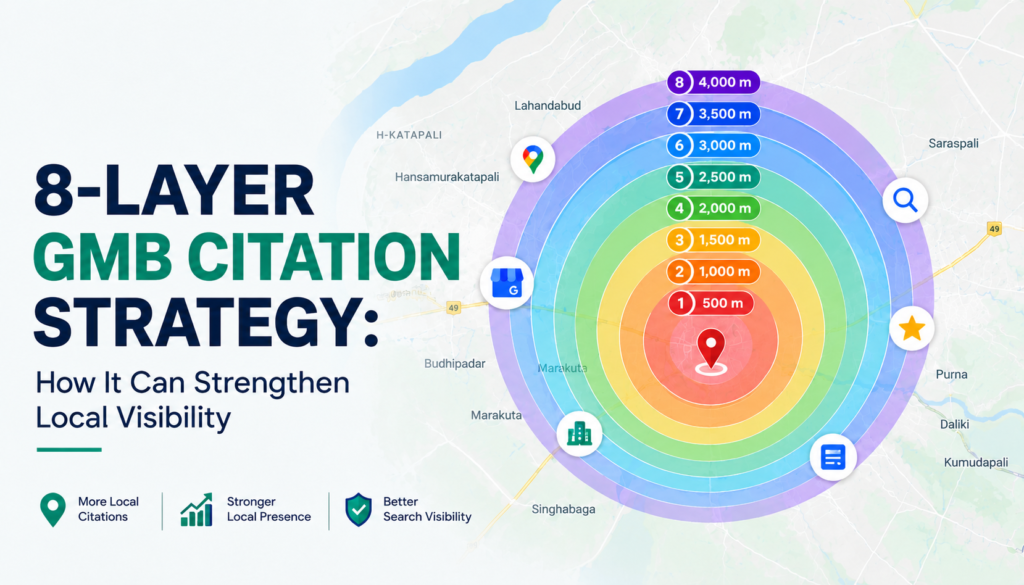
A common approach some local SEO professionals use is an 8 layer GMB citation strategy. Instead of dropping citations kind of randomly, this method organizes citation building into different geographic layers around the business area.
The whole thing is actually pretty straightforward: you begin with the area closest to the business, then you slowly widen the coverage as you move from one layer to the next.
In this strategy, the first layer covers a radius of about 500 meters, then each next layer adds another 500 meters. So by the eighth layer, you’re looking at a total approximate radius of around 4 kilometers.
Let’s break down how this approach plays out, and also why businesses might include it in their overall local visibility plan.
What Is an 8-Layer GMB Citation Strategy?
An 8-layer GMB citation strategy is kinda a structured way to build local business citations around a given business location, like you’re focusing on where it’s really based.
Instead of treating every citation source the same, the strategy splits them into eight geographic layers, step by step.
In other words the reach expands each time, the radius increases by 500 meters with every layer:
Layer Approximate Coverage
Layer 1 500 meters
Layer 2 1,000 meters
Layer 3 1,500 meters
Layer 4 2,000 meters
Layer 5 2,500 meters
Layer 6 3,000 meters
Layer 7 3,500 meters
Layer 8 4,000 meters
The purpose is to create a structured local presence that begins around the business and gradually expands into surrounding areas.
It is important to understand that this 8-layer, 500-meter model is a strategic citation-building methodology, not an official Google ranking requirement.
Why Start With the Closest Area?
The first layer focuses on the immediate area around the business.
For a local company, nearby customers are often the most valuable audience. Someone searching for a restaurant, salon, clinic, hotel, repair service, or marketing agency may prefer a business located close to them.
Therefore, the first stage of GMB citation building can focus on highly relevant local platforms and directories associated with the immediate location.
For example, if a business is located in a particular commercial area, the initial local citation strategy can prioritize relevant local directories and platforms that help establish the business within that area.
Layer 1: 500-Meter Radius
Layer 1: 500-Meter Radius
In the first layer you’re basically looking at the closest 500-meter zone around the business. Here the key idea is to set a solid starting point for the GMB citation profile, and not sort of rush it.
In this phase businesses can work on local business directories, nearby community platforms, and those relevant local listings. Also, location-specific directories, plus industry listings that actually serve the immediate area.
The business name, address, phone number, website, and other key details need to be accurate, and consistent across every GMB listing and also every local citation. Like, no random variations, not even small ones that might confuse systems or people.
Also Read : YouTube Monetization Rules: New Creators Face New Challenges
Layer 2: 1-Kilometer Radius
The second layer takes things further, to about 1 kilometer. Now, businesses can broaden their reach to include more local directories and platforms that cover the surrounding neighborhood.
The goal here is pretty straightforward: add more relevant places where potential customers can discover the business, while keeping the information consistent. This stage of GMB citation building should still emphasize quality and relevance, rather than just stacking up citation volume for the sake of it.
Layer 3: 1.5-Kilometer Radius
For the third layer, you’re covering roughly 1.5 kilometers out from the business location. This can include extra neighborhood-level platforms, and also city-area options that are a bit wider than before.
At this point the rule stays the same, keep focusing on relevance, and don’t only think “more citations.” A citation on a genuinely relevant local or industry platform can outperform a listing on an unrelated website, even if that other site has more traffic or looks bigger.
Layer 4: 2-Kilometer Radius
Then comes the fourth layer, expanding the approach to around 2 kilometers. At this stage, a business can begin targeting broader local directories and platforms that cover several neighborhoods, not just one.
If the business serves customers across a larger local area, this can help build a wider online presence.
Layer 5: 2.5-Kilometer Radius
Layer five extends the rough reach to 2.5 kilometers. kinda like you’re widening the net, but still staying close to where people actually search.
At this point, the focus can drift toward broader nearby platforms and more niche, industry specific directories. Like, a digital marketing agency might look at marketing and business listings, while a hotel may lean into travel plus hospitality platforms.
The kind of GMB citation you build should really match the business itself and also who it wants to attract. That’s why citation building that stays relevant is generally worth more than simply creating profiles for quantity, you know just to get numbers up.
Layer 6: 3-Kilometer Radius
The sixth layer covers about 3 kilometers.
This step can move toward wider local and regional platforms, so the business isn’t only showing up in that very tight area.
Businesses can also revisit their current GMB citations during this phase to find duplicate entries, or places where something is just wrong. GMB citation building shouldn’t be treated as a one time activity. Existing info should be reviewed, checked, and refreshed regularly so customers see the right details.
Layer 7: 3.5-Kilometer Radius
The seventh layer expands coverage to roughly 3.5 kilometers.
Here, the business can aim for more relevant platforms serving the surrounding area, even if it’s not exactly the same street or neighborhood.
Consistency becomes especially important at this stage, because the amount of local citations may have jumped quite a bit. So, check things like:
- Business name
- Address
- Phone number
- Website
- Category
- Business hours
If anything looks outdated, update it wherever possible.
Layer 8: 4-Kilometer Radius
The eighth and last layer covers approximately 4 kilometers.
This one gives the widest geographic coverage inside this 8-layer model.
Even so, the priority stays on relevant local, industry, and regional platforms, not on creating listings just to hit a predetermined number.
After the eight layers are done, businesses can carry on …
Why NAP Consistency Matters in GMB Citation Building
One of the most important parts of GMB citation building is maintaining consistent NAP information.
NAP stands for:
Name + Address + Phone Number
For example, if a business uses one phone number on its Google Business Profile but a different number on several directories, it can create confusion for potential customers.
Businesses should therefore use consistent core information across important GMB citations and local business listings.
This is particularly important when a business moves to a new location, changes its phone number, or updates its official business name.
Should You Create GMB Citations on Every Website?
No.
More GMB citations ,doesnt automatically translate into better local visibility. I mean sure, the numbers matter a bit but not like that, not by themself. What tends to matter is the quality ,the relevance ,and the accuracy of the citations.
So a business should really focus on the right kind of mentions, like
- Relevant local directories
- Industry specific platforms
- Trusted business directories
- Location based websites
- Appropriate review platforms
Because adding tons of listings across random places, or irrelevant low quality sites ,just to bump the citation count can backfire or at least waste effort.
In general a focused GMB citation strategy is usually more useful than a method that is built purely around volume.
Also Read : SEO Website Audit: A Complete Step-by-Step Guide to Improve Your Website Rankings
How the 8-Layer GMB Citation Strategy Fits Into Local Marketing?
The 8-layer approach should be considered one part of a broader local marketing strategy.
A strong local presence can also involve:
- Google Business Profile optimization
- Genuine customer reviews
- Local website content
- Location pages
- Local backlinks
- Accurate business information
- Relevant directory listings
- Social media presence
- Regular profile updates
- GMB citation building and management
GMB citations can support the broader local SEO ecosystem by helping maintain consistent business information across relevant online platforms.
Citations alone should not be treated as a guarantee of higher Google Maps rankings.
Google considers multiple signals when determining local search results, and businesses should focus on building a trustworthy and useful online presence overall.
Common Mistakes in Layer-Based GMB Citation Building
Businesses can make several mistakes when implementing a GMB citation strategy.
Creating Too Many Irrelevant Listings
The goal is not to create citations everywhere. Focus on platforms that make sense for the business.
Inconsistent Business Information
Different names, phone numbers, or addresses across GMB citations can create confusion.
Duplicate Listings
Creating multiple listings for the same business on the same platform can cause unnecessary problems.
Ignoring Existing Citations
Before creating new GMB citations, businesses should check whether an old listing already exists.
Treating the Radius as a Google Rule
The 500-meter progression is part of the 8-layer GMB citation strategy, not an official Google requirement. Businesses should use the model as an organized methodology rather than claiming that Google requires citations to be built at these exact distances.
Also Read : AI Search Engines vs Google Search: What Is Changing?
Conclusion
The 8-layer GMB citation strategy gives a sort of organized way to handle local citation building, even if it feels a bit layered.
You start at around 500 meters, then each next layer expands by another 500 meters, and eventually the whole idea drifts out toward a wider local radius of about 4 kilometers.
The real value here is not just the number of layers, or even the distance you cover. It’s more the structured process of putting out relevant, precise, and steady business details across the right local , and also industry platforms.
For companies that want to boost their local presence, GMB citation building can run together with Google Business Profile optimization, reviews, local content, backlinks, and other local marketing actions too.
If you do it carefully, a structured GMB citation strategy can help build a steadier online footprint, and it can make it simpler for nearby customers to locate correct information about a business.