YouTube has become one of the biggest platforms for creators to build an audience and earn money online. From long-form videos and Shorts to memberships, Shopping, and advertising, the platform offers several ways for eligible creators to generate income.
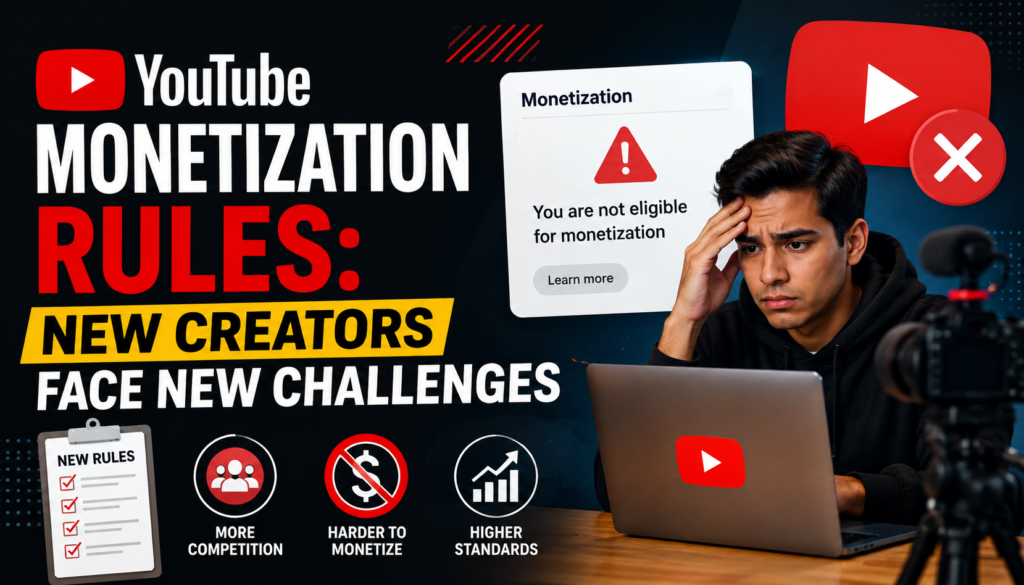
However, creators now need to pay closer attention to the quality and originality of their content. Recent YouTube Monetization Rules have put greater emphasis on original, authentic, and valuable content, particularly when it comes to repetitive or mass-produced videos.
This does not mean that YouTube has suddenly doubled the eligibility requirements for new creators. Instead, the platform has clarified its existing monetization policies to make it clear that repetitive and mass-produced content may not qualify for monetization.
What Has Changed in YouTube Monetization Rules?
On July 15, 2025, YouTube updated its “repetitious content” policy and renamed it “inauthentic content.” According to YouTube, the update was mainly a clarification of an existing policy rather than a completely new monetization rule.
The platform has always required monetized content to be original and authentic. The updated policy specifically highlights content that is mass-produced, repetitive, generic, or created mainly to generate views without providing meaningful value to viewers.
This means creators who repeatedly upload videos using almost identical templates, scripts, narratives, or formats could face monetization problems if the videos do not offer enough original value.
For new creators, this makes content quality more important than simply uploading a large number of videos.
Who Could Be Affected?
The updated YouTube Monetization Rules can affect channels whose content appears highly repetitive or mass-produced.
For example, YouTube says that content may have monetization problems when videos are created using a template with very little variation or when viewers receive almost the same experience from one video to another.
Image slideshows, templated stories, and scrolling text with little or no original narration, commentary, or educational value can also be problematic.
Creators should therefore avoid producing large numbers of videos that are almost identical except for minor changes.
At the same time, having a similar format across videos does not automatically mean that a channel cannot be monetized. Creators can use the same intro or outro, for example, as long as the main substance of each video is meaningfully different.
What Are the Current YouTube Monetization Requirements?
The current requirements for full advertising revenue through the YouTube Partner Program remain important for creators.
According to YouTube, a channel can become eligible for ad revenue by reaching:
- 1,000 subscribers and 4,000 valid public watch hours in the last 12 months, or
- 1,000 subscribers and 10 million valid public Shorts views in the last 90 days.
These requirements apply to the higher YouTube Partner Program threshold that provides access to Watch Page Ads, Shorts Feed Ads, and YouTube Premium revenue.
There is also an expanded entry point to the YouTube Partner Program in eligible countries. Creators can qualify for certain fan-funding and Shopping features with 500 subscribers, three public uploads in the last 90 days, and either 3,000 public watch hours in the last 12 months or 3 million public Shorts views in the last 90 days.
Therefore, creators should understand that not every monetization feature has exactly the same eligibility requirements.
What About Shorts Creators?
Shorts remain an important part of YouTube’s creator ecosystem. However, Shorts creators also need to focus on originality and audience value.
For full ad revenue through Shorts, YouTube currently lists the requirement of 1,000 subscribers and 10 million valid public Shorts views within 90 days.
Simply producing hundreds of similar Shorts may not be a sustainable monetization strategy. If videos look mass-produced or provide little variation or value, they may fall under YouTube’s inauthentic-content policy.
Creators should instead focus on unique ideas, original storytelling, useful information, strong editing, and content that gives viewers a reason to watch.
Can AI-Generated Content Be Monetized?
The updated policy has also created confusion around artificial intelligence.
Using AI does not automatically make a video ineligible for monetization. Creators can use AI tools to support storytelling and content creation. The important factor is whether the final content provides original and authentic value.
The problem arises when creators use AI or automation to mass-produce highly similar videos with little human input, originality, or meaningful variation.
For example, a channel that repeatedly uploads nearly identical AI-generated stories or slideshows with the same narration structure could face monetization issues.
On the other hand, using AI to help with research, editing, visuals, or storytelling can still be compatible with monetization when the creator adds genuine creative input and produces valuable content.
Reused Content Is Still an Important Issue
Another area creators need to understand is reused content.
Uploading someone else’s videos, clips, or online content with only minor changes may not qualify for monetization. YouTube expects creators to add significant original commentary, modifications, educational value, or entertainment value when using material created by others.
For example, reaction videos, reviews, and commentary can be monetized when they provide meaningful original input. Simply downloading and reposting clips without substantial transformation is much riskier.
This means creators should not rely on copied content simply because it is already popular.
How Can New Creators Stay Safe?
New creators can reduce monetization risks by following a few simple principles.
First, create content around your own ideas, experiences, knowledge, or creative perspective. Second, make sure every video provides something useful, entertaining, or informative to the audience.
Creators should also avoid uploading large numbers of almost identical videos just to increase views or watch time.
If you use AI tools, editing software, or templates, make sure the final video still reflects your own creative direction.
It is also important to follow YouTube’s Community Guidelines, copyright rules, and advertiser-friendly content policies.
Meeting the subscriber and watch-hour requirements alone does not guarantee YPP approval. YouTube reviews channels before accepting them into the program.
The Future of YouTube Monetization
The direction of the platform is becoming increasingly clear: quality matters more than quantity.
YouTube is not simply asking creators to upload more videos. The platform wants content that viewers find useful, interesting, and authentic.
For new creators, this means building a channel around a clear niche, developing an original content style, and understanding what the audience actually wants to watch.
Instead of creating dozens of similar videos, creators should focus on producing fewer but stronger pieces of content.
Also Read : Google Gemini AI: Features, Benefits, Uses & Latest Updates (2026)
Conclusion
The latest YouTube Monetization Rules do not mean that earning money on YouTube has suddenly become impossible for new creators. The current YPP eligibility thresholds for ad revenue remain clearly defined by YouTube.
The bigger focus is on originality, authenticity, and meaningful content. Channels that rely heavily on repetitive, mass-produced, or reused content may face monetization challenges, while creators who bring their own ideas, knowledge, and creative value can continue to build sustainable channels.
For anyone planning to start a YouTube channel in 2026, the message is simple: don’t focus only on views. Focus on creating content that people genuinely want to watch.