
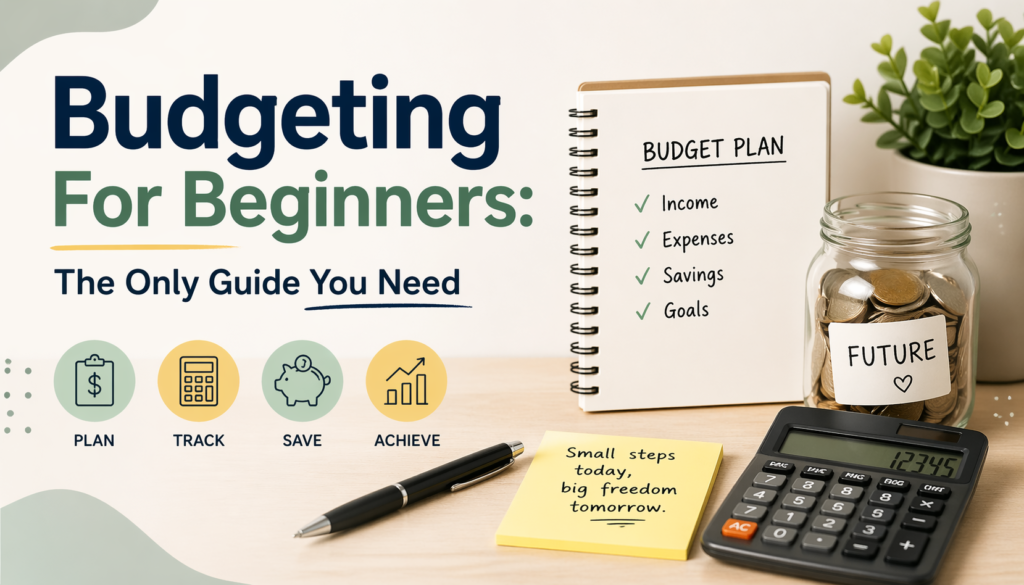
People who begin their financial management journey face numerous challenges because money management has multiple complexities. A person can handle their financial situation without needing to become a finance professional. With the right approach, budgeting for beginners can be simple, practical, and even empowering. The guide provides complete instructions which help you develop a budget and maintain it to achieve your financial goals.
What is Budgeting and Why Does It Matter?
At its core, budgeting is the process of tracking your income and expenses to ensure you’re spending your money wisely. For those new to personal finance, budgeting for beginners is about understanding where your money goes and making conscious decisions about how to use it.
A good budget helps you:
- Avoid unnecessary debt
- Save for future goals
- Reduce financial stress
- Gain control over your spending habits
The absence of a budget creates problems because it leads to excessive spending which results in a complete loss of your financial priorities.
Step 1: Understand Your Income
The first step in budgeting for beginners is knowing exactly how much money you earn each month. This includes:
- Salary or wages
- Freelance or side income
- Any additional earnings
You need to compute your net income after deducting taxes and other deductions because that amount represents your actual spending capacity.
Step 2: Track Your Expenses
People should begin their expense tracking process after establishing their income. Many beginners face difficulties at this point because it serves as a fundamental element for creating an effective budget.
Your expenses need to be divided into two different groups.
- Fixed expenses: Rent, EMIs, insurance, subscriptions
- Variable expenses: Food, shopping, entertainment, travel
You will achieve better understanding of your financial behavior through one month of expense tracking. Many people are surprised to see how small daily expenses add up over time.
Step 3: Set Financial Goals
The beginners need to establish their financial goals because it serves as their primary purpose for budgeting. Ask yourself:
- Do you want to save for a vacation?
- Are you building an emergency fund?
- Do you want to pay off debt?
The establishment of short-term and long-term objectives will provide your budget with both direction and motivational support. The absence of objectives makes it simple to become distracted which leads to the reappearance of previous buying behaviors.
Step 4: Choose a Budgeting Method
You can select from multiple budgeting techniques that match your personal lifestyle requirements and your individual preferences. The popular options include these two choices:
1. The 50/30/20 Rule
- 50% for needs (rent, bills, groceries)
- 30% for wants (entertainment, dining out)
- 20% for savings and debt repayment
This budget approach represents one of the most straightforward options which beginners can use to create their budgets.
2. Zero-Based Budgeting
The method requires you to assign every rupee a specific function. Your income minus expenses should equal zero, ensuring that no money is left unaccounted for.
3. Envelope Method
You distribute cash into multiple envelopes which represent different expense categories such as food, travel, and shopping. The envelope becomes empty, which leads you to stop spending money for that particular expense category.
Step 5: Create Your Budget Plan
The time has arrived to combine all elements into a complete plan. You should develop your monthly budget based on your income and expenses together with your financial objectives.
You need to complete the following tasks:
- You should give primary importance to necessary costs
- You need to reserve funds for your future financial needs
- You must establish spending boundaries for items that you do not need
Budgeting for beginners requires you to maintain complete financial control. The process requires you to achieve equilibrium while making better decisions.
Step 6: Build an Emergency Fund
An emergency fund functions as a financial buffer which protects people from unexpected costs that arise from medical expenses and job termination and emergency maintenance needs. The target should be to build a savings account that contains three to six months of your regular spending needs.
For beginners, start small. The process of saving small amounts each month leads to substantial results throughout the time. The implementation of this step stands as a fundamental requirement for beginners who need to establish their financial base through budgeting.
Step 7: Monitor and Adjust Regularly
The budget needs ongoing attention because you cannot make it and then forget about it. Your budget requires updates because life events require you to update your financial plan.
Review your budget monthly:
- Are you overspending in certain categories?
- Can you increase your savings?
- Do your goals need updating?
Your progress will improve when you make regular financial adjustments which will help develop your spending patterns throughout time.
Tips to Stick to Your Budget
Staying consistent is often the hardest part. Here are some simple tips to help you stick to your budget:
- Use budgeting apps or spreadsheets
- Automate your savings
- Avoid impulse purchases
- Reward yourself occasionally
- Stay focused on your financial goals
Consistency is key when it comes to budgeting for beginners.
Conclusion
Starting your financial journey may seem challenging, but with the right mindset and tools, anyone can succeed. Budgeting for beginners is not about perfection—it’s about progress. Your income understanding combined with your expense control and your goal commitment will enable you to establish a solid financial base.
Take the first step today. Your financial results will improve when you make minor changes to your money management practices.
Also Read : Phishing Scams in 2026: What’s New & How to Stay Safe