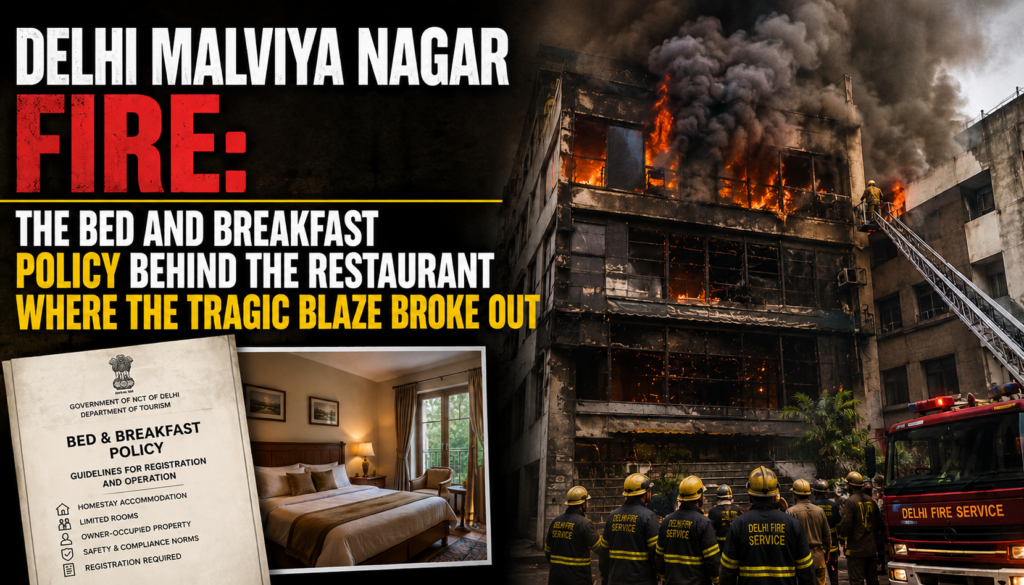
The Delhi Malviya Nagar Fire has emerged as one of the most heartbreaking incidents in recent times, raising serious questions about safety regulations, illegal commercial activities, and regulatory loopholes in the national capital. The tragic fire, which broke out in a multi-storey building operating under the name Lemon Green Restaurant in Delhi’s upscale Malviya Nagar area, quickly turned into a devastating disaster that claimed the lives of 21 people.
The incident is not just being seen as an accident but as a reflection of how violations of safety norms and misuse of licensing systems can put human lives at risk. Investigations into the Delhi Malviya Nagar Fire have revealed concerns surrounding the type of license under which the establishment was allegedly operating — a Bed and Breakfast (B&B) license.
Major Questions Raised Over Licensing
One of the most shocking revelations in the aftermath of the Delhi Malviya Nagar Fire revolves around licensing irregularities. Preliminary findings suggest that the establishment, despite functioning like a commercial hospitality business, allegedly did not possess a proper commercial hotel license.
Instead, reports indicate that the building may have been operating under a Bed and Breakfast (B&B) license — a category designed primarily for small-scale residential accommodation facilities rather than large commercial establishments. This revelation has triggered discussions over whether such policies are being misused to bypass strict commercial regulations.
What Is the Bed and Breakfast (B&B) Policy?
The Bed and Breakfast policy was introduced by India’s Ministry of Tourism to promote affordable accommodation for travelers while allowing homeowners to earn additional income.
Under the B&B framework introduced in 2007, homeowners are allowed to rent out extra rooms in their residential properties to guests. The idea behind the initiative was to create safe, affordable, and culturally immersive accommodation experiences for tourists.
The policy was primarily designed for:
- Promoting tourism
- Offering affordable accommodation
- Supporting local homeowners financially
- Providing tourists with a homely environment
The concept was never intended to replace commercial hotels or large hospitality businesses.
Origin and Purpose of the B&B Scheme
The Indian government introduced this initiative under the “Incredible India” campaign in 2007. The main objective was to provide international and domestic tourists with opportunities to experience Indian culture, local traditions, and family-style hospitality.
Additionally, the scheme aimed to create supplementary income opportunities for middle-class households that had spare rooms available for guests.
The policy gained significant momentum during preparations for the 2010 Commonwealth Games in Delhi when accommodation demand increased sharply due to the expected arrival of thousands of international visitors.
Why Did the Policy Become Popular During the Commonwealth Games?
When Delhi prepared to host the Commonwealth Games in 2010, authorities anticipated a shortage of hotel rooms due to rising tourist numbers. To bridge this gap, the government promoted residential accommodation models under the B&B scheme.
As a result, many homeowners registered their properties under the policy, contributing to increased tourism capacity without requiring massive hotel infrastructure expansion.
However, experts now argue that insufficient monitoring may have allowed certain establishments to misuse the framework.
Important Conditions for Obtaining a B&B License
The government established several conditions for homeowners seeking approval under the Bed and Breakfast scheme.
Some key requirements include:
Owner Occupancy Requirement
The most important condition is that the property owner must live in the same premises. The policy is specifically designed for owner-occupied homes and not for independent commercial hospitality businesses.
Limited Number of Rooms
A B&B establishment can typically offer only a limited number of guest rooms, usually ranging between one and six rooms.
Residential Nature of Property
The property must remain residential in character and should not be transformed into a full-fledged commercial enterprise.
These rules were introduced specifically to prevent large-scale commercial misuse.
Difference Between a Commercial Hotel and a B&B Establishment
The Delhi Malviya Nagar Fire has highlighted the importance of understanding the difference between a hotel and a Bed and Breakfast property.
Bed and Breakfast Establishments:
- Owner lives on the property
- Limited guest rooms
- Family-oriented atmosphere
- Primarily residential setup
- Basic hospitality services
Commercial Hotels:
- Operate as independent businesses
- Can have restaurants and event spaces
- Require multiple regulatory approvals
- Higher guest capacity
- More stringent safety compliance requirements
This distinction becomes important because safety standards differ significantly between the two categories.
Licensing and NOC Requirements
One reason the B&B model became popular is because the approval process is comparatively simpler.
In many cases, establishing a B&B involves:
- Limited paperwork
- Tourism department registration
- Fewer initial compliance requirements
By contrast, commercial hotels generally require:
- Municipal approvals
- Commercial trade licenses
- Fire department clearances
- Police permissions
- Multiple No Objection Certificates (NOCs)
The Delhi Malviya Nagar Fire has intensified concerns over whether simplified rules may sometimes create opportunities for misuse.
Safety Standards and Commercial Operations
Commercial hotels are expected to maintain strict safety protocols because they accommodate larger numbers of guests and often include restaurants, banquet spaces, or conference facilities.
These safety requirements typically include:
- Fire exits
- Emergency response systems
- Fire extinguishers
- Evacuation routes
- Occupancy regulations
When establishments operate beyond the scope of their approved category, questions naturally arise regarding whether sufficient safety infrastructure exists.
Also Read : IMD Issues Yellow Alert Across Himalayan States Amid Heavy Rain Forecast
Who Issues B&B Licenses in Delhi?
Individuals seeking to operate a Bed and Breakfast facility in Delhi generally require approvals from local tourism authorities and relevant government departments.
The registration process is largely digital and involves submitting property details and compliance-related information through official channels.
At the national level, tourism authorities classify certified B&B establishments under categories such as:
- Gold Category
- Silver Category
These classifications are intended to maintain quality standards and transparency.
Room Size and Minimum Standards
The B&B framework also specifies certain physical requirements for accommodation spaces.
These typically include:
- Legally constructed properties
- Minimum room size requirements
- Basic emergency arrangements
- Cleanliness standards
- First-aid availability
- Safe guest access routes
Although requirements may differ from commercial hotels, guest safety remains an essential expectation.
Self-Certification and New Regulatory Changes
Recent policy discussions have focused on simplifying approvals through self-certification systems.
Under newer draft proposals:
- Applicants may self-certify information
- Faster approvals may be introduced
- Authorities retain inspection powers
- Surprise audits remain possible
Supporters argue this improves efficiency, while critics worry about potential misuse if oversight remains weak.
Restrictions on Commercial Activities
Perhaps the most important restriction under the B&B framework is that license holders cannot freely operate unrelated commercial activities under residential permissions.
Activities generally restricted include:
- Large restaurants
- Bars
- Commercial entertainment venues
- High-capacity hospitality operations
The ongoing investigation into the Delhi Malviya Nagar Fire has reignited concerns over whether establishments operating beyond permitted limits are escaping regulatory scrutiny.
Also Read : Amarnath Yatra 2026: Extensive Security Measures in Place as 670 Additional CAPF Companies Are Deployed
Conclusion
The Delhi Malviya Nagar Fire has become more than a tragic incident — it has turned into a national conversation about urban safety, licensing loopholes, and regulatory enforcement. As investigators continue examining the causes and compliance failures behind the incident, the tragedy serves as a reminder that rules around occupancy, fire safety, and licensing exist to protect lives.
The coming weeks may determine whether this devastating incident leads to stricter enforcement and improved accountability within Delhi’s hospitality sector.