
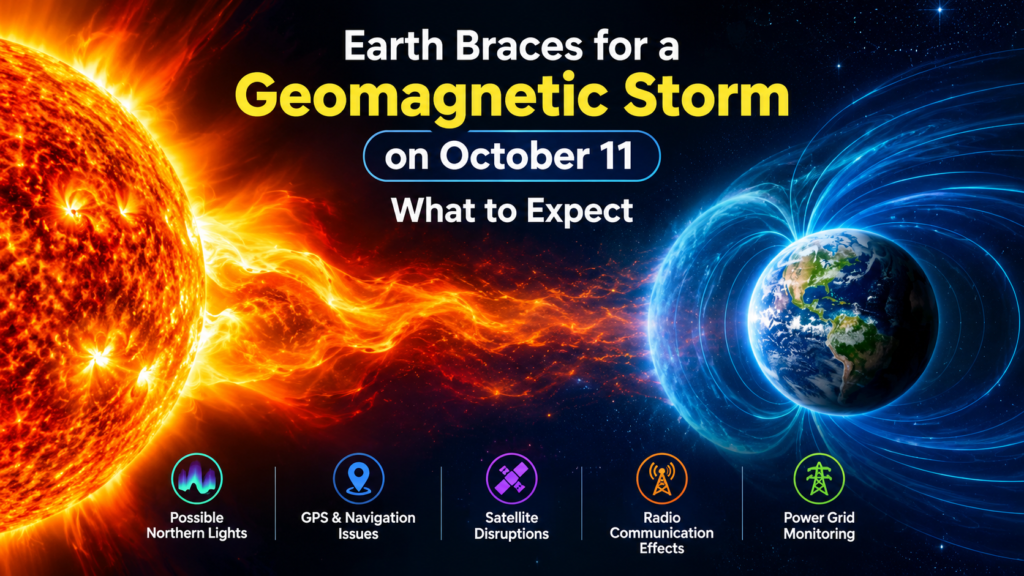
Scientists are keeping a close eye on the Sun as a possible space weather event approaches Earth. A Geomagnetic Storm could affect our planet on October 11, 2026, as solar material travels through space toward Earth’s magnetic field. The forecast has raised questions about the possibility of northern lights, GPS issues, satellite disruptions, and other effects. But what does this really mean for people on Earth, and should you be concerned?
Let’s look at what is known, what could happen, and what to expect from the upcoming solar storm.
What Is the Latest Geomagnetic Storm Forecast?
According to the reported forecast from the US National Oceanic and Atmospheric Administration (NOAA), a G2, or moderate, geomagnetic storm watch has been issued for October 11, 2026.
The forecast is linked to two coronal mass ejections (CMEs) that erupted from the Sun. These events send large amounts of magnetised plasma into space. If the material reaches Earth and interacts with its magnetic field, it can trigger a geomagnetic storm.
When two CMEs travel in the same direction, the faster one can catch up with the slower one. This interaction may influence the speed and strength of the material that eventually reaches Earth.
However, there is an important distinction between a storm watch and a confirmed event. A watch means conditions may be favourable for a geomagnetic storm; it does not guarantee that the predicted intensity will occur.
Scientists will continue monitoring space weather conditions to determine how the situation develops.
What Is a Geomagnetic Storm, and Why Does It Happen?
Earth is surrounded by a magnetic shield called the magnetosphere. It helps protect our planet from the constant flow of charged particles released by the Sun.
Sometimes, the Sun becomes more active and releases enormous clouds of magnetised material known as coronal mass ejections. When these clouds travel toward Earth, they can disturb the magnetosphere and transfer energy into Earth’s magnetic environment.
This disturbance is known as a geomagnetic storm.
Solar flares are another form of solar activity, but they are different from coronal mass ejections. Solar flares release bursts of radiation, while CMEs carry large quantities of plasma and magnetic fields into space. Both can influence space weather, although their effects are not identical.
Geomagnetic storms are classified on a five-level scale, from G1 (minor) to G5 (extreme). A G2 storm is considered moderate. It can affect certain technologies, but it does not automatically mean that widespread disruptions will occur.
What Could Happen During the October 11 Solar Storm?
The actual effects will depend on how fast the incoming solar material travels, how dense it is, and how its magnetic field interacts with Earth’s magnetic field.
Here are some of the possible effects scientists and space weather specialists monitor during geomagnetic storms.
1. Could the Northern Lights Become More Visible?
One of the most exciting possibilities during a geomagnetic storm is the appearance of brighter auroras.
The northern lights, also called the aurora borealis, occur when energetic particles interact with gases in Earth’s upper atmosphere. This process creates the beautiful green, purple, and sometimes red lights seen in the night sky.
During stronger geomagnetic activity, auroras can sometimes be seen farther away from the polar regions than usual.
However, this does not mean everyone will get a chance to see them. Visibility depends on the storm’s strength, geographical location, cloud cover, darkness, and light pollution.
For people in India, the northern lights are not expected to be a routine outcome of this moderate storm forecast. Anyone hoping to see an aurora should check a reliable local aurora forecast rather than assume it will be visible.
2. Could GPS and Navigation Systems Be Affected?
Many people rely on GPS every day, whether they are driving, travelling, delivering goods, or using location-based apps.
Geomagnetic storms can disturb the ionosphere, a layer of Earth’s upper atmosphere that satellite navigation signals pass through. These disturbances can sometimes reduce positioning accuracy or affect systems that require highly precise navigation.
The impact depends on the strength of the storm and where the disturbance occurs. Certain specialised applications, such as surveying and precision navigation, may be more sensitive than ordinary smartphone navigation.
That said, a G2 geomagnetic storm watch does not mean your phone’s GPS will stop working. Most people should not expect major everyday navigation problems simply because a storm has been forecast.
3. What About Satellites in Space?
Satellites play a major role in modern life. They support weather forecasting, communications, navigation, broadcasting, and Earth observation.
During geomagnetic storms, changes in the upper atmosphere can cause it to heat up and expand. This increases atmospheric drag on some satellites orbiting relatively close to Earth, potentially affecting their orbital paths.
Changes in the space environment can also create challenges for satellite electronics and communication systems.
Satellite operators keep track of space weather forecasts so they can assess potential risks and take appropriate action if necessary. The level of concern depends on the severity and duration of the storm.
4. Could Radio and Communication Services Be Disrupted?
Solar activity can sometimes affect radio signals, particularly high-frequency radio communications used by aviation, maritime services, and other specialised operations.
Solar flares can cause radio blackouts, while geomagnetic disturbances can affect how certain signals travel through the atmosphere.
The important point is that not all communication systems respond in the same way. A geomagnetic storm watch does not mean mobile networks, Wi-Fi, or internet services will automatically stop working.
For most people, there is no reason to expect a widespread communication outage from a moderate storm forecast alone.
5. Is There a Risk of Power Outages?
Power grids are another area that space weather specialists monitor during geomagnetic storms.
Strong disturbances in Earth’s magnetic field can induce electrical currents in long power transmission lines. Under certain conditions, these currents can place additional stress on electrical equipment and affect grid operations.
However, the risk varies according to the storm’s intensity, local geology, and the design of the electricity network.
A G2 storm is classified as moderate, and widespread power outages should not be treated as an expected outcome of this forecast. Grid operators monitor conditions to identify and manage potential risks.
Will the Geomagnetic Storm Affect Human Health?
Whenever news of a solar storm spreads, people naturally want to know whether it could affect their health.
For most people on the ground, a moderate geomagnetic storm is not expected to pose a direct health threat. Earth’s atmosphere and magnetic field provide substantial protection from many forms of solar activity.
The main concerns associated with geomagnetic storms involve technological systems rather than everyday human activities.
Astronauts and some high-altitude aviation operations may face additional radiation-related considerations during certain space weather events. These risks are monitored by relevant agencies and operators.
It is also worth separating scientific evidence from online rumours. There is no reliable scientific evidence that an ordinary geomagnetic storm directly causes widespread headaches, anxiety, or other common health symptoms in the general population.
In simple terms, most people do not need to change their daily routine because of a moderate geomagnetic storm watch.
How Can You Follow the Latest Solar Storm Updates?
Solar storm forecasts can change as new measurements become available. If you want to know whether the October 11 event is developing as expected, the best approach is to follow reliable sources.
Here are a few simple steps:
- Check official forecasts: Visit NOAA’s Space Weather Prediction Center for the latest geomagnetic storm watches, warnings, and forecasts.
- Look for aurora updates: If you live in a region where auroras may be visible, check local forecasts and weather conditions before heading outdoors.
- Follow trusted sources: Rely on recognised space weather agencies instead of unverified social media posts predicting internet shutdowns or widespread blackouts.
- Monitor relevant service alerts: If your work depends on precise GPS positioning or specialised radio communications, check updates from your service provider.
You do not need special equipment or emergency preparations simply because a moderate geomagnetic storm watch has been issued.
Also Read More About: Lakers vs Kings Game Recap: How LA Secured a 114-110 Victory
What Happens Next?
The October 11, 2026, solar storm forecast is a reminder that activity on the Sun can sometimes affect the environment around Earth in ways that are not immediately visible to us.
If the incoming coronal mass ejections interact strongly with Earth’s magnetic field, a geomagnetic storm could develop. Depending on its intensity, the event may create favourable conditions for auroras and cause some disturbances to satellite navigation, radio communications, or other technologies.
But a forecast is not a guarantee of disruption. The final impact will depend on the properties of the incoming solar material and how Earth’s magnetosphere responds.
For now, there is no need to assume that widespread blackouts, internet failures, or serious health effects will occur. Following official space weather updates is the best way to understand any changes in the forecast.
As scientists continue observing the Sun and monitoring Earth’s magnetic field, the coming updates should provide a clearer picture of what to expect.
Stay informed about the latest geomagnetic storm forecast, solar activity, and space weather alerts to understand how changing conditions in space could affect our planet.


Pingback: Nepal Floods 2026: Flash Flood Damage in Gorkha