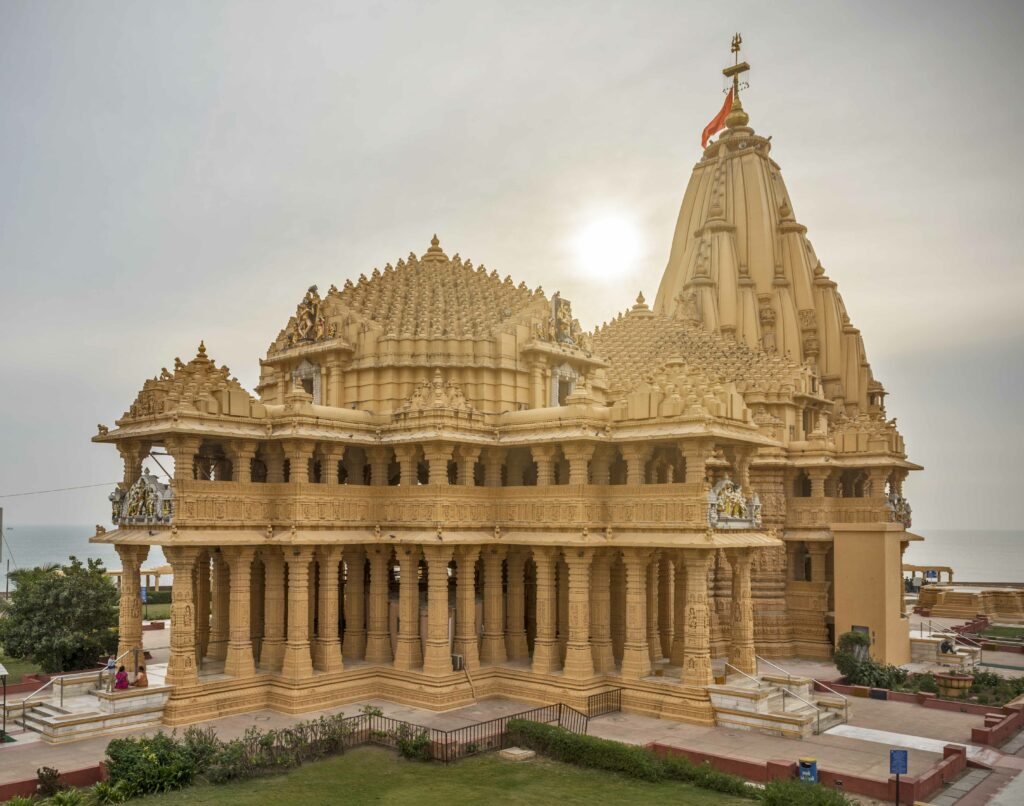
The Somnath Jyotirlinga Temple, located in Gujarat, is one of the most sacred pilgrimage sites for Hindus and a powerful symbol of faith, resilience, and spiritual strength. It is considered the first among the twelve Jyotirlingas of Lord Shiva, making it one of the holiest Shiva temples in India. More than just a place of worship, the temple represents the unbreakable spirit of Sanatan Dharma and India’s rich cultural heritage.
For centuries, the Somnath Jyotirlinga Temple has stood as a witness to repeated invasions, destruction, looting, and reconstruction. Despite numerous attacks by invaders and rulers from different periods of history, the temple continued to rise again and again. Its survival is seen by many as proof of the eternal presence of Lord Shiva and the unwavering devotion of millions of devotees.
Today, on 11 May 2026, the temple marks the 75th anniversary of its modern reconstruction and inauguration through the celebration of Somnath Amrit Mahotsav. Prime Minister Narendra Modi, in a special article, described the temple’s journey as a symbol of “creation from destruction,” highlighting how the temple reflects India’s cultural consciousness, living faith, and national pride.
The Most Famous Attack on Somnath Temple
Although the Somnath Jyotirlinga Temple faced several attacks in history, the most talked-about invasion happened in the 11th century when Mahmud of Ghazni attacked the temple.
Around 1024 CE, Mahmud Ghazni, the ruler of Ghazni, invaded India with a large army of nearly 5,000 soldiers and targeted the temple because of its immense wealth and spiritual importance. He destroyed large parts of the temple and looted huge amounts of gold, silver, jewels, and other valuables. Historical accounts also mention that many devotees lost their lives during this brutal attack.
This event is considered one of the biggest attacks on Indian culture, civilization, and Hindu faith. However, Mahmud Ghazni was not the first invader to attack the temple, nor was he the last.
First Destruction of Somnath Temple – 725 CE
The first recorded attack on the Somnath Jyotirlinga Temple happened in 725 CE. During this period, Al-Junaid, the Muslim governor of Sindh, launched an invasion and ordered the destruction of the temple.
Historians consider this the first major attack on Somnath. The temple suffered serious damage, but its spiritual importance remained strong among devotees.
Mahmud Ghazni’s Second Major Attack – 1024 CE
The second and most famous destruction came in 1024 CE when Mahmud Ghazni attacked the temple. He entered Gujarat with a powerful army and targeted Somnath because of its fame and wealth.
He looted the temple’s treasures and destroyed the sacred structure. This invasion became one of the most discussed events in Indian history because of the scale of destruction and the emotional impact it had on Hindu society.
Attack by Alauddin Khalji’s General – 1297 CE
In 1297 CE, Nusrat Khan, the general of Delhi Sultanate ruler Alauddin Khalji, attacked the Somnath Jyotirlinga Temple once again.
He damaged the temple structure and looted wealth and valuables from the temple premises. This attack added another painful chapter to the temple’s history.
Gujarat Sultanate Attacks – 1395 and 1412 CE
The temple was attacked again during the Gujarat Sultanate period.
In 1395 CE, Sultan Muzaffar Shah attacked the temple and caused significant destruction. Later, in 1412 CE, his son Ahmad Shah also launched an attack on the Somnath Jyotirlinga Temple, leading to further damage and looting.
These repeated invasions showed how the temple remained a constant target because of both its religious importance and material wealth.
Aurangzeb’s Rule and the Temple’s Destruction
During the reign of Mughal emperor Aurangzeb, the temple faced destruction twice—first in 1665 CE and again in 1706 CE.
Aurangzeb’s rule is remembered for several temple destructions across India, and Somnath was one of the major religious centers affected during that time.
Even after these attacks, the devotion of the people did not weaken.
Reconstruction of Somnath Temple After Every Destruction
The history of the Somnath Jyotirlinga Temple is not only about destruction but also about continuous reconstruction and revival.
Every time the temple was attacked, rulers and devotees came forward to rebuild it.
Reconstruction by Nagabhata
After Al-Junaid’s invasion, Gurjara-Pratihara king Nagabhata rebuilt the temple around 815 CE. His efforts restored the temple and revived worship.
Rebuilding After Mahmud Ghazni’s Attack
Following Mahmud Ghazni’s invasion, King Bhimdev of Gujarat and King Bhoj of Malwa took responsibility for rebuilding the temple.
Their efforts helped restore the temple’s religious importance and gave hope to devotees.
Reconstruction After Alauddin Khalji’s Attack
When Nusrat Khan damaged the temple during Alauddin Khalji’s rule, Hindu kings once again rebuilt the sacred structure and continued religious activities.
Ahilyabai Holkar’s Contribution
In 1783 CE, Maharani Ahilyabai Holkar of Indore built a new Somnath temple near the original site. She restarted worship and helped revive the temple’s religious traditions.
Her contribution played a major role in keeping the spiritual legacy of Somnath alive.
Also Read : Swanand Kirkire And Sudhir Mishra Reunite For Summer of 77
Modern Reconstruction After Independence
After India gained independence, Sardar Vallabhbhai Patel took a historic step toward restoring the temple in its grand form.
Known as the Iron Man of India, Patel visited Somnath and took a vow by holding seawater in his hand that the temple would be rebuilt magnificently.
His vision turned into reality when the reconstruction project was completed.
On 11 May 1951, India’s first President, Dr. Rajendra Prasad, performed the Pran Pratishtha ceremony (consecration) of the temple.
This day is considered the rebirth of the modern Somnath Jyotirlinga Temple and remains a historic moment in independent India.
Somnath Amrit Mahotsav 2026
Today, as the temple celebrates 75 years of its modern inauguration through Somnath Amrit Mahotsav, people across the country are remembering its extraordinary journey.
Prime Minister Narendra Modi described Somnath as a symbol of India’s eternal faith and strength. He said the temple reflects the nation’s ability to rise from destruction and rebuild with even greater power.
The temple is not just a religious place—it is a living example of cultural survival and spiritual victory.
Conclusion
The story of the Somnath Jyotirlinga Temple is a story of destruction, faith, and rebirth. From repeated invasions by foreign rulers to its grand reconstruction in modern India, the temple has stood as a symbol of resilience and divine power.
Its history teaches that while physical structures may be destroyed, faith can never be erased. The temple’s repeated revival proves that spiritual devotion is stronger than any invasion.Today, the Somnath Jyotirlinga Temple continues to inspire millions of devotees and stands proudly as one of India’s greatest symbols of Sanatan tradition, national pride, and timeless devotion to Lord Shiva.