
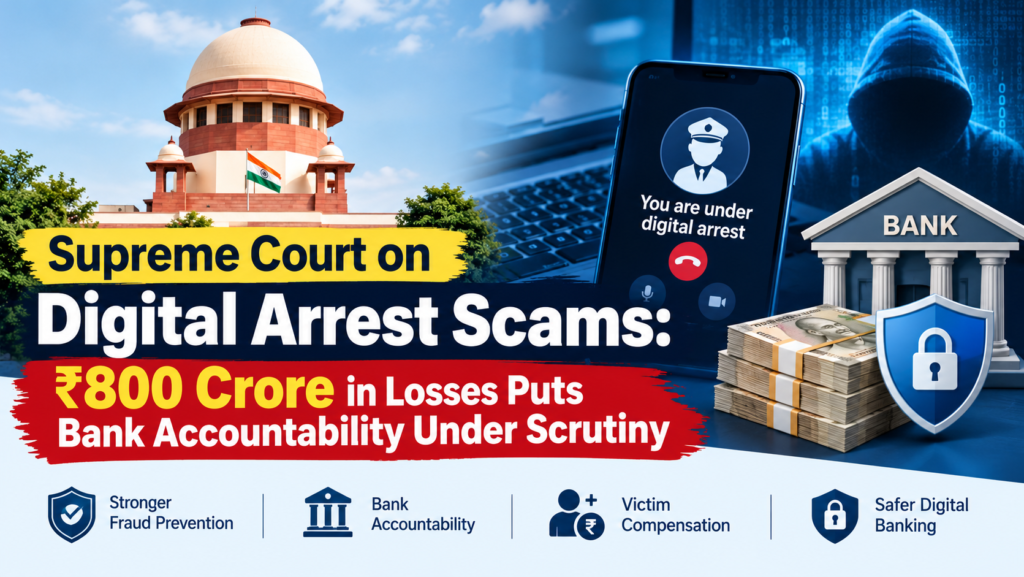
India’s fight against cybercrime has reached a critical point as digital arrest scams continue to cost people their hard-earned savings. On October 29, 2026, the Supreme Court raised serious concerns over nearly ₹800 crore in losses linked to these scams this year and questioned whether banks are doing enough to protect their customers. The Supreme Court digital arrest scams hearing has brought two important issues into focus: preventing suspicious transactions before money disappears and ensuring bank compensation for cyber fraud when a financial institution’s failure to exercise due diligence contributes to the loss. <Cite refs={[“turn519301search1″,”turn519301search3”]}/>
Why Is the Supreme Court Raising Concerns About Digital Arrest Scams?
Digital arrest scams have become a serious concern because fraudsters are finding ways to exploit people’s fear of legal trouble. They impersonate police officers, CBI officials or other government authorities and convince victims that they are connected to a criminal investigation.
During the October 29 hearing, a bench led by Chief Justice Surya Kant questioned why such frauds continue despite public awareness campaigns, media reports and previous court interventions. The Court also emphasised that banks should do more than simply report suspicious activity after the money has been transferred. <Cite refs={[“turn519301search2″,”turn519301search10”]}/>
The central question is straightforward: if a bank could have identified and stopped a suspicious transaction, should it be held responsible when its failure allows a customer to lose money?
The Court indicated that it was considering stronger measures to hold financial institutions accountable where a failure in due diligence contributes to cyber fraud. This could have important implications for digital arrest scams in India and the wider approach to online financial security. <Cite refs={[“turn519301search1″,”turn519301search8”]}/>
How Do Digital Arrest Scams Work?
A digital arrest scam usually begins with an unexpected phone call or video call. The caller claims to represent a law enforcement agency and tells the victim that their name, phone number, bank account or identity documents are linked to a criminal case.
The fraudster may use fake identification, fabricated documents and intimidating language to make the story sound convincing. Victims may be told not to speak to family members or may be pressured to remain on video calls while the scammers continue their threats.
Eventually, the victim is instructed to transfer money for supposed verification, security clearance or another invented legal requirement.
These tactics work by creating panic and preventing people from thinking clearly. Even financially experienced individuals can be targeted when fraudsters apply sustained pressure.
It is important to remember that a video call does not place someone under legal arrest. Requests to transfer money to prove innocence or avoid arrest should be treated as major warning signs.
What Does the ₹800 Crore Figure Tell Us?
The nearly ₹800 crore in losses highlighted by the Supreme Court shows the scale of the financial damage associated with digital arrest scams this year. The amount also raises questions about how quickly stolen money can move between accounts before authorities have an opportunity to intervene. <Cite refs={[“turn519301search3″,”turn519301search9”]}/>
One part of the problem is the use of money mule accounts. These are bank accounts used to receive or transfer money connected to criminal activity. Fraudsters may use accounts controlled by other people to move stolen funds through several transactions, making the money harder to trace.
Once funds have moved through multiple accounts, cash withdrawals or other channels, recovery can become more difficult. That is why online banking fraud prevention needs to focus on identifying suspicious activity early rather than relying only on investigations after the incident.
The Court also heard that reported digital arrest cases had declined compared with the previous year. However, the substantial losses show that more work may be needed to protect potential victims. <Cite refs={[“turn519301search3″,”turn519301search0”]}/>
Should Banks Compensate Victims of Cyber Fraud?
One of the most significant issues raised during the hearing was bank compensation for cyber fraud.
The Supreme Court said the proposed regulatory framework should provide for compensation where an investigation establishes that a financial institution’s failure to exercise due diligence contributed to the fraud. The Court discussed compensation of at least the amount lost in such cases. <Cite refs={[“turn519301search1″,”turn519301search8”]}/>
This does not mean that every person who loses money to an online scam will automatically receive a refund. The key issue is whether the bank failed to meet its responsibilities and whether that failure contributed to the loss.
The Court’s approach could encourage financial institutions to review how they identify unusual transactions, respond to fraud alerts and protect customers whose banking activity suddenly changes.
For customers, the issue is especially important because losing savings to a scam can have long-term consequences. For banks, it highlights the importance of effective safeguards and timely action.
What Changes Could Improve Online Banking Fraud Prevention?
The Court highlighted several possible measures to help banks and authorities identify suspicious transactions before losses occur. <Cite refs={[“turn519301search1″,”turn519301search3”]}/>
1. Flag unusual transactions
Banks could strengthen systems that identify transactions that differ significantly from a customer’s normal banking behaviour. A sudden, unusually large transfer may warrant additional checks, depending on the circumstances.
2. Pause transactions for verification
Where a transaction appears suspicious, temporarily holding it while its legitimacy is checked could help prevent money from reaching fraudsters. Any such measure would need to follow the applicable regulatory framework and safeguards.
3. Improve reporting and coordination
Automated alerts and timely communication between banks and law enforcement agencies could help investigators respond faster when fraud is suspected.
4. Strengthen customer verification
Additional verification may help establish whether a transaction was genuinely authorised by the account holder, particularly when there are signs of coercion or unusual activity.
5. Address money mule accounts
Better detection of accounts used to receive and move fraud proceeds could make it more difficult for criminal networks to transfer stolen funds rapidly.
Together, these steps could strengthen cyber fraud protection in India by moving the focus towards prevention, early detection and accountability.
RBI’s Proposed KYC Directions: What Happens Next?
The Supreme Court said it would examine the Reserve Bank of India’s proposed RBI KYC Amendment Directions 2026 before issuing further directions. It also asked the RBI to provide information about the financial institutions that would be covered and the proposed measures for compensating victims where due diligence failures are established. <Cite refs={[“turn519301search2″,”turn519301search8”]}/>
KYC, or Know Your Customer, procedures help banks verify customer identities and maintain appropriate account information. However, preventing fraud also requires effective transaction monitoring, timely reporting and the ability to identify suspicious activity.
The proposed regulatory measures are expected to address these concerns, with the Court indicating that it would examine the framework before proceeding further. The final requirements and their implementation will depend on the regulatory process and subsequent court directions.
For customers, the outcome could help clarify how banks are expected to respond when suspicious transactions put their money at risk.
How Can You Protect Yourself From a Digital Arrest Scam?
While banks and regulators have a role to play, individuals can also take practical steps to avoid becoming victims.
- Stay calm when someone threatens arrest. Scammers rely on fear and urgency to pressure people into acting without verification.
- Never transfer money for supposed police verification. Do not send funds because a caller claims it is necessary to prove your innocence.
- Verify the caller independently. Contact the relevant agency using official contact details rather than numbers supplied by the caller.
- Protect your banking information. Never share OTPs, PINs, passwords or other confidential financial details.
- Tell someone you trust. If a caller demands secrecy or prevents you from contacting family, treat it as a warning sign.
- Report financial cyber fraud immediately. In India, call 1930 and file a complaint through the National Cyber Crime Reporting Portal.
Quick reporting may help authorities and banks act on suspicious transfers, although the recovery of lost money cannot be guaranteed.
Understanding digital arrest fraud awareness and reporting procedures can make a real difference, particularly when scammers are trying to isolate victims and prevent them from seeking advice.
Also Read More About: PM Kisan 24th Instalment 2026: Release Date, Eligibility and Payment Status
Conclusion: A Stronger Approach to Digital Fraud Is Needed
The Supreme Court’s hearing has placed digital arrest scams in India and bank accountability firmly in the spotlight. With nearly ₹800 crore in losses highlighted during the proceedings, the challenge is not simply to investigate fraud after it happens, but to identify suspicious transactions early enough to prevent further damage.
The Court’s observations have also raised important questions about cybercrime victim compensation, the responsibilities of financial institutions and the safeguards customers should be able to expect from digital banking.
As the RBI’s proposed KYC directions come under review, the next steps could help shape India’s response to cyber-enabled financial crime. Stronger transaction monitoring, faster reporting and clearer accountability may help reduce the risks faced by customers.
Ultimately, protecting people from digital arrest scams requires more than awareness alone. It calls for coordinated action by banks, regulators, law enforcement agencies and the public—so that fraudsters find it harder to exploit fear and harder to move stolen money.


Pingback: Karwa Chauth 2026: Moon Not Visible? 3 Traditional Ways
Pingback: Abdul Samad’s Sensational 143: Jammu & Kashmir Batter Rescues Team Against Baroda in Ranji Trophy 2026 - blogs.digitalgrowth.media