
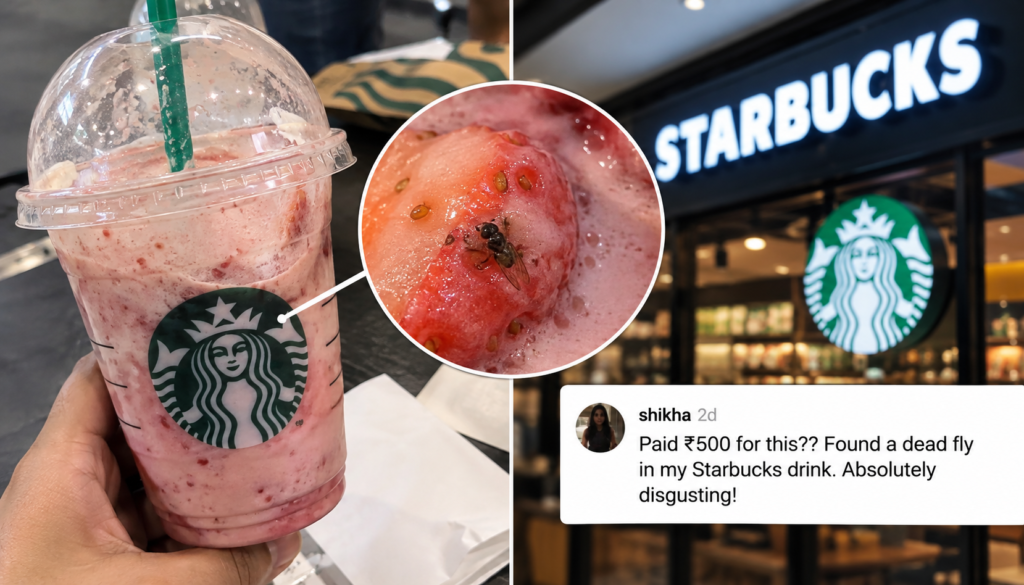
The viral Starbucks incident has left social media users asking a very simple question: how does a dead fly end up stuck to a piece of strawberry inside a drink?
A Delhi-based content creator, Shikha, recently shared a video of what she said was a dead fly found in her Starbucks beverage. The drink reportedly cost around ₹500, and the video quickly spread online as viewers reacted to the apparent hygiene issue.
The post caught attention not just because of the insect, but because of the price. When someone pays ₹500 for a drink from a major international coffee brand, expectations around cleanliness and quality are naturally going to be high.
Starbucks India responded to the post, apologized for the customer’s experience and asked her to share her contact details so its customer-care team could follow up.
What Happened in the Viral Starbucks Incident?
The viral Starbucks incident began with a video shared by Shikha on Instagram. In the clip, she showed a Starbucks takeaway cup and zoomed in on a piece of strawberry with what appeared to be a dead fly attached to it.
She questioned the hygiene standards of the outlet and pointed out that she had paid around ₹500 for the beverage.
The video was enough to get people talking almost immediately.
According to reports, the post did not clearly identify the exact Starbucks outlet in the original video. Some reports have described it as an airport outlet, while other coverage noted that the specific location was not identified in the post itself. The timing of the purchase was also not clearly stated.
Why Did the Video Go Viral?
There is something about finding an unexpected object in food or a drink that instantly grabs attention.
Add a familiar brand, a ₹500 price tag and a close-up video, and it becomes the kind of post people naturally share with friends.
The reaction also moved beyond Starbucks itself. Users began discussing food hygiene in cafes, ingredient handling and whether premium restaurants and coffee chains should have stricter quality checks.
Some comments even tagged food-safety officials and called for the matter to be investigated. However, reports available so far do not indicate that authorities had inspected the outlet or taken action based on the social-media post.
How Did Starbucks India Respond?
Starbucks India did not ignore the post.
The company responded directly in the Instagram comments, apologizing for the experience and asking the creator to share her contact number so that the customer-care team could contact her.
That response became another part of the online conversation.
For a brand dealing with a rapidly spreading complaint, responding publicly can be important. People are already watching, screenshots can circulate and silence can sometimes create even more questions.
Starbucks Says It Is Reviewing the Matter
There is another side to the story that is important to include.
According to NDTV, a TATA Starbucks spokesperson said the company had initiated a review after getting in touch with the customer. The company said its review so far had not indicated any hygiene issues or process lapses at the store.
That means the social-media video and the company’s subsequent review should be treated as two parts of an ongoing situation rather than as proof of a confirmed, company-wide hygiene failure.
Why the ₹500 Price Tag Became Such a Big Part of the Story
If the drink had cost ₹100, would people have reacted differently?
Possibly.
The price became one of the most discussed details because customers often connect premium pricing with premium expectations. If someone spends ₹500 on a beverage, they are not simply paying for the ingredients. They are also paying for the brand, presentation, service and the expectation of a consistent experience.
That is why the Starbucks drink controversy has resonated with people who may never have visited the particular outlet involved.
Customers Expect More From Premium Brands
Nobody expects a restaurant or café to be completely immune from mistakes. Human beings prepare food, ingredients move through different stages and unexpected problems can happen.
But customers do expect businesses to have systems that reduce those risks.
That includes checking ingredients, keeping preparation areas clean, storing food properly and making sure staff follow established food-handling procedures.
When something appears to go wrong, customers naturally want to know what happened.
Does One Viral Incident Prove Starbucks Has a Hygiene Problem?
No.
This is where the online conversation needs a little caution.
The video shows what the customer says she found, and multiple news outlets have reported on it. But that alone does not establish how the fly entered the drink or whether the incident resulted from a broader problem at the outlet.
Starbucks’ own review, as reported by NDTV, said it had not found hygiene issues or process lapses at the store so far.
A Single Complaint Is Not the Same as a Pattern
A food contamination incident can be serious without automatically proving that an entire chain has unsafe practices.
To establish a wider pattern, you would need more evidence: inspections, repeated complaints, documented violations or findings from the relevant authorities.
That distinction is especially important when a story is spreading rapidly online.
Social media is very good at showing people what happened—or what someone says happened. It is not always enough to explain why it happened.
Why Food Hygiene Matters in Cafes
The viral Starbucks incident has also brought attention back to something customers rarely think about when ordering a drink: everything that happens before it reaches the counter.
A fruit-based beverage can involve several ingredients and preparation steps. Fresh fruit has to be handled, stored and prepared correctly. Cups, utensils, counters and other food-contact surfaces also need appropriate cleaning.
Small Checks Can Prevent Bigger Problems
Good hygiene is usually not about one dramatic action.
It is the everyday stuff:
- Checking ingredients before use
- Keeping preparation areas clean
- Storing fresh produce properly
- Maintaining clean utensils and containers
- Following pest-control procedures
- Training staff in food-safety practices
- Checking the finished product before serving it
These steps may sound ordinary, but consistency is what makes food-safety systems work.
What This Incident Says About Brand Reputation
There is another reason the viral Starbucks incident matters, especially for large consumer brands.
A customer complaint used to stay between the customer and the business. Today, a phone camera can turn that complaint into a public story within hours.
One short video can be watched by people across the country who have never even visited the outlet involved.
That changes how brands have to handle customer complaints.
The First Response Matters
A brand cannot control whether a customer posts a complaint online.
It can control how it responds.
Acknowledging the concern, contacting the customer and investigating the situation gives the company a chance to understand what happened instead of allowing social media speculation to become the only version of the story.
In this case, Starbucks India publicly responded and said its team would contact the customer. TATA Starbucks later said a review had been initiated.
Could the Incident Affect Customer Trust?
Possibly, but the extent is difficult to measure from a viral post alone.
People often remember visual incidents much more easily than ordinary positive experiences. A close-up image of a dead insect in a drink can therefore stay in someone’s mind long after the original post disappears from their feed.
That is one reason Starbucks hygiene concerns have become such a prominent part of the discussion.
At the same time, one viral post should not automatically be treated as representative of every Starbucks outlet or every customer’s experience.
What Can Businesses Learn From the Viral Starbucks Incident?
The biggest takeaway for food and beverage businesses is not simply “avoid going viral.”
It is to make sure the basics are strong enough that preventable complaints are less likely to happen in the first place.
Hygiene Has to Be Consistent
Cleaning a counter once is not enough. Checking ingredients once is not enough either.
Food safety depends on routines being followed throughout the day, even when nobody is watching.
Customer Complaints Need Proper Follow-Up
A customer who reports a problem wants more than a generic apology.
They want to know that the business has actually listened and is trying to understand what went wrong.
That can matter just as much for reputation as the original incident.
Viral Stories Need Facts, Not Just Reactions
The internet can move faster than an investigation.
Readers should distinguish what a video shows from what researchers have confirmed.
In this case, the presence of what appeared to be a dead fly was the focus of the viral post, while the exact cause and circumstances remained under review. Starbucks’ reported internal review had not identified a hygiene or process lapse at the store at that stage.
Final Thoughts
The viral Starbucks incident is more than another social-media controversy. It shows how quickly a customer’s experience can become a national conversation when a familiar brand, an unexpected hygiene concern and a premium price come together.
In her video, a Delhi creator claimed that a dead fly attached itself to a strawberry in a ₹500 Starbucks drink. Starbucks India apologized and asked to contact her, while TATA Starbucks later said it had begun reviewing the matter and had not found hygiene or process issues at the store so far.
For customers, the incident is a reminder to speak up when something seems wrong. This incident reveals how food safety and customer trust relate closely.
For everyone watching the story unfold online, adopt the simplest and most sensible approach: examine the reports, separate claims from confirmed findings, and wait for the facts before drawing bigger conclusions.