CBSE 12th Result 2026 Out and the announcement has sparked major discussions among students, parents, and teachers across the country. The Central Board of Secondary Education (CBSE) officially declared the Class 12 board exam results on May 13, 2026, and this year’s overall pass percentage stands at 85.20%.
This number is slightly lower compared to last year’s 88.39%, leading to widespread debate on social media. Many people are now questioning whether the new On-Screen Marking (OSM) system is responsible for the drop in the pass percentage.
Several students and parents have expressed concerns that digital evaluation may have affected marks negatively. However, CBSE has strongly denied these claims and clarified that the OSM system is not the reason behind the lower pass percentage.
Let’s understand what really happened and why the passing graph has dropped this year.
CBSE 12th Result 2026 Out: Is OSM Responsible for Lower Pass Percentage?
As soon as the news of the reduced passing percentage came out after the declaration of the Class 12 results, many reports and social media posts started blaming the On-Screen Marking (OSM) system.
Some people claimed that teachers faced difficulties while adapting to the new digital checking method, which may have impacted the final results. According to these claims, technical challenges and unfamiliarity with the system may have led to stricter marking or errors in evaluation.
However, CBSE Examination Controller Sanyam Bhardwaj completely rejected these rumors.
The board clearly stated that OSM has made the evaluation process more transparent, accurate, and reliable than ever before. According to CBSE, the system is designed to improve the quality of checking and reduce human mistakes, not to lower students’ scores.
CBSE emphasized that OSM is a positive step toward modernization and fairness in examination assessment.
What Is the On-Screen Marking (OSM) System?
The On-Screen Marking (OSM) system is a digital evaluation process where teachers check answer sheets on a computer screen instead of physically handling paper copies.
After the exams are completed, answer sheets are scanned and uploaded into the system. Examiners then log in and evaluate each answer digitally using secure software.
This system offers several advantages:
- Eliminates totaling mistakes
- Reduces chances of human error
- Ensures better monitoring of examiners
- Improves transparency
- Speeds up the result process
- Makes rechecking more accurate
Unlike manual checking, where marks can sometimes be added incorrectly, OSM automatically calculates the total marks, leaving no room for calculation mistakes.
This is one of the major reasons why CBSE believes the system improves overall fairness.
Why Did the Passing Percentage Drop in 2026?
Even though many people are blaming OSM, experts believe the actual reasons are quite different.
Compared to 2025, the pass percentage has dropped by nearly 3%, but this decline may be linked more to strict accuracy than technical problems.
1. No More Totaling Errors
In traditional paper evaluation, students sometimes benefited from totaling mistakes where marks were added incorrectly, often resulting in extra marks.
With OSM, every mark is calculated automatically by the system. This removes accidental over-marking and ensures exact scoring.
While this improves fairness, it can also slightly reduce the overall pass percentage.
2. Stricter and More Precise Checking
Another major reason is the stricter evaluation process.
Under OSM, teachers have to check each answer with proper digital tracking. Every step is monitored, making random grace marking less common.
This means students only receive marks based on their actual performance, not due to examiner leniency.
Although this may reduce pass percentages, it improves the quality and credibility of the evaluation.
3. Higher Difficulty Level of Papers
Experts also suggest that some 2026 board exam papers were more difficult compared to previous years.
Subjects like Physics, Mathematics, and Accountancy were reportedly tougher for many students. A higher difficulty level naturally impacts overall scores and may reduce the number of high scorers.
This factor may have contributed more significantly to the lower pass percentage than the OSM system itself.
CBSE’s Official Response on OSM Controversy
CBSE has made it clear that the On-Screen Marking system should not be blamed for the lower results.
According to the board, OSM is helping create a more trustworthy and standardized evaluation process.
Officials stated that:
- The system increases transparency
- Human intervention errors are minimized
- Every answer is checked more carefully
- Students receive fair and accurate marks
The board also added that students and parents should avoid believing rumors circulating on social media without official confirmation.
CBSE believes that the focus should be on understanding the improved evaluation standards rather than spreading misinformation.
Student and Parent Reactions
After the announcement that CBSE 12th Result 2026 Out, many students were shocked by the slight drop in the pass percentage.
Parents also started questioning whether digital evaluation had become too strict. Some students felt that they deserved higher marks and blamed technology for lower scores.
However, education experts say that transparency should be welcomed rather than feared.
A fair result system helps deserving students get accurate recognition and also strengthens trust in the examination process.
While the transition to digital evaluation may feel uncomfortable at first, it is expected to benefit the education system in the long run.
Can Students Apply for Rechecking?
Yes, students who are not satisfied with their marks can still apply for:
- Verification of marks
- Photocopy of answer sheet
- Re-evaluation of specific answers
Since the OSM system stores digital copies securely, rechecking becomes even more efficient and transparent.
Students are advised to carefully review their scorecards before applying for any re-evaluation process.
Also Read : Therapy vs Self-Help: Which One Do You Need?
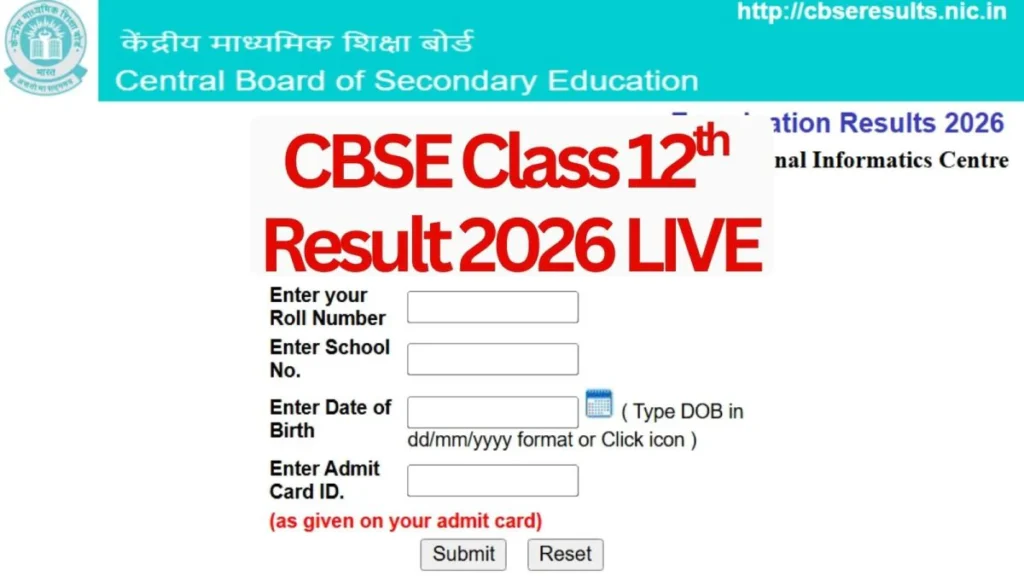
Where to Check CBSE Class 12 Results
Students who want to check their results can visit the official CBSE websites:
- https://www.cbse.gov.in/
- https://cbseresults.nic.in/
They can also access results through DigiLocker and UMANG app using their roll number, school number, and admit card details.
The board has advised students to use only official portals and avoid fake websites or unofficial result links.
Final Conclusion
CBSE 12th Result 2026 Out has certainly created major discussion due to the lower pass percentage of 85.20%, but blaming the OSM system may not be correct.
In reality, On-Screen Marking has improved the accuracy, fairness, and transparency of the evaluation process. The drop in pass percentage appears to be more connected to stricter checking, elimination of totaling errors, and slightly tougher exam papers.
Although students may feel disappointed with lower marks, the long-term goal of such reforms is to create a more honest and reliable education system.
Instead of seeing OSM as a problem, it should be viewed as a step toward better academic evaluation and a stronger future for Indian education.
Also Read : Somnath Jyotirlinga Temple: The Story of Destruction, Looting, and Rebirth Through History