
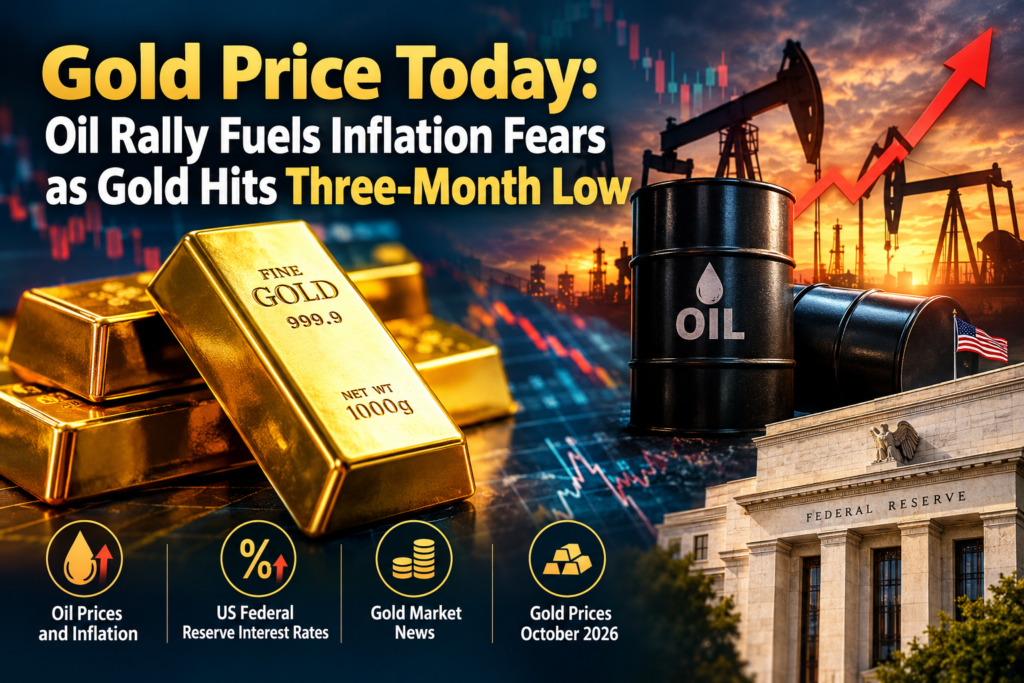
The value of gold faces downward pressure due to the increase in the price of crude oil, which raises fears about inflation and increases the possibility that interest rates will remain high for longer periods of time. Investors following Gold price today are closely monitoring these developments and their impact on precious metals, economic indicators, and central bank policies.
On October 23, 2026, the price of spot gold saw an upward move from its three-month low, but it still headed for the steepest fall in a week since June. As reported by Reuters, the price of spot gold went up slightly to $4,026 per ounce from $3,986.50, the lowest since July 20. The price had declined by about 3.5% that week.
If you want to know what has caused the price of gold to go down in recent times, despite its reputation as an inflation hedge, the answers to your questions lie in the connection between oil prices, inflation expectations, interest rates, and investor sentiments. This is an important development for anyone following the Gold price today.
Why Are Gold Prices Falling Despite Inflation Concerns?
Gold is frequently seen as the storage of value during times of economic insecurity. Gold prices may not always rise along with an increase in the level of inflation. The stock market is also affected by changes in interest rates and foreign exchange, among other things.
There are three primary factors affecting the market currently.
1. Rising Oil Prices Are Renewing Inflation Fears
Oil serves as a key raw material in transportation, industry, power generation, and logistics. As the price of oil increases, firms could incur higher operation costs and pass them along to customers.
On October 23, the price of Brent oil was above its level of more than five months due to concerns about possible supply disruptions from the Middle East. This made inflation look likely to persist.
Increases in the cost of energy will impact inflation via the cost of fuel, shipping, and production. This will give limited scope for lowering interest rates by central banks.
To investors who watch the trend of Oil prices and inflation, this relationship is relevant since increased energy costs will impact the movement of gold among other financial instruments.
2. Interest Rates Could Limit Gold’s Appeal
Whereas other financial instruments such as savings account, bonds issued by governments and fixed income financial products pay out interest regularly, gold is one instrument which pays no interest.
With interest rates being high and yields from bonds remaining at similar levels, individuals can benefit from investing in interest bearing financial products.
The fear of rising interest rates has caused the prices of gold to be affected negatively.
Inflation has continued to be high because of expensive energy. This situation can mean that the monetary policy of central banks will continue to be contractionary for some time to come.
3. Investors Are Watching the US Federal Reserve
The US Fed is a key player in global financial markets as its decisions on the interest rates affect the dollar, US treasuries, and investments around the world.
The attention of investors is focused on the results of the October 27-28 FOMC meeting and subsequent data on US inflation. These developments are important for those tracking US Federal Reserve interest rates.
In case there are signs that interest rates will be kept high, gold may come under additional pressure. On the other hand, positive expectations from rate cuts may positively affect the metal.
It all depends, but the coming economic reports are essential for those who track Gold market news.
Gold Prices October 2026: What the Latest Movement Tells Investors
The recent pullback underscores how fast precious metal markets react to shifts in economic sentiments.
The journey of gold up towards the $4,000 per ounce mark has increasingly become a critical aspect for market players. However, there is no reason to regard any certain price point as an assured floor or indication that the prices will reverse.
According to Reuters, gold fell by about 3.5% for the week by October 23rd. The decline came as a result of the prior successive weeks of decline due to rising energy costs and tightening monetary policy expectations.
It is important for investors to distinguish between temporary and fundamental issues.
For instance, an investor buying gold for jewellery may be interested in local prices, commission fees, taxes, and urgency of buying. While a person who trades gold futures may be more focused on technical points, market liquidity, currency factors, and economic data releases.
Since these are different purposes, the same price movement means something different to various market players.
For more market context, one may consider Indian Express gold rates information for various cities and gold qualities.
How Could the Gold Price Today Affect Buyers in India?
International gold price is just one of the factors that determine the cost of gold in India. Domestic prices can be affected by the rupee-dollar exchange rate, costs of import, taxes, domestic demand, and the charges relating to jewelry.
If there is a fall in international prices, then it presents an opportunity for consumers, but the fall will not necessarily equate to a similar decrease in domestic retail prices.
Some issues that consumers need to take into consideration before buying gold include:
Check Local Rates Before Buying
Compare the current prices of 24 karat, 22 karat, and 18 karat gold based on the planned purchase. Consult prices from trusted local jewelers to find out if the prices include tax.
Separate Investment Goals From Jewellery Purchases
Jewellery purchases often involve costs such as manufacturing expenses that may not necessarily equate to any resale value. Financial investments need to be separately analyzed on cost, liquidity, and personal financial goals.
Avoid Decisions Based on One Day’s Movement
A sudden drop in prices may tempt buyers into investing, but the price levels may still fall further as long as market conditions are not favorable. Think about your investment objectives and how well you can handle falling prices.
Follow Currency and Interest-Rate Developments
However, a weakened rupee can make the local price of imported gold expensive despite lower international prices. Other considerations that may affect international bullion prices include interest rates and bond yields in the United States. It is therefore essential to consider international prices and local market trends before making a purchase.
Will Gold Prices Recover After Gold Hits Three-Month Low?
However, a recovery might happen, but it will be contingent on the manner in which economic and geopolitical factors evolve.
First, various elements can help bolster prices. For instance, a fall in crude oil prices would help relieve any inflation fears and dampen long-term restrictive monetary policies. Lower bond yields, a weaker US dollar, or increased demand for havens could also help boost optimism about gold.
Secondly, energy market interruptions, persisting inflation, real interest rates, and a stronger US dollar could continue putting pressure on prices.
Lastly, investors need to note that gold moves as a result of the interplay of various factors. Gold could be supported by central bank buying, investments inflows, jewelry demand, and geopolitics despite pressure from rising interest rates.
As such, the recent fall does not help determine if gold is at its low point for the year. The new economic data and policy moves should be watched rather than relying on three-month lows as an indication of a turnaround.
What to Watch in the Coming Days
The following key events to watch out for are the Federal Reserve’s interest rate decision of October 27-28 and the US PCE Inflation data for October 29.
These events might shape expectations of future interest rates and offer more insights into inflation pressures. Crude oil price movements and developments impacting energy supply will also be important for the market outlook. For buyers from India, regular reports on gold price movement in the domestic market will prove useful in getting a better understanding.
Readers can stay updated on financial news and gain insights into how changing economic conditions impact precious metals, particularly through the latest Gold market news.
Conclusion
However, a recent fall in gold prices is an indicator that worries about inflation will not necessarily lead to an increase in gold prices. The rise in the cost of oil can fuel inflation expectations while at the same time prompting the expectation of higher interest rates, thus opposing pressures on gold.
As of October 23, 2026, prices have moved higher but continue to be pressured by the expectation of monetary tightening.
A person who is interested in Gold price today must track oil prices, decisions of the Fed, bond yields, currency moves and other factors before being able to say something about the next trend in the market.