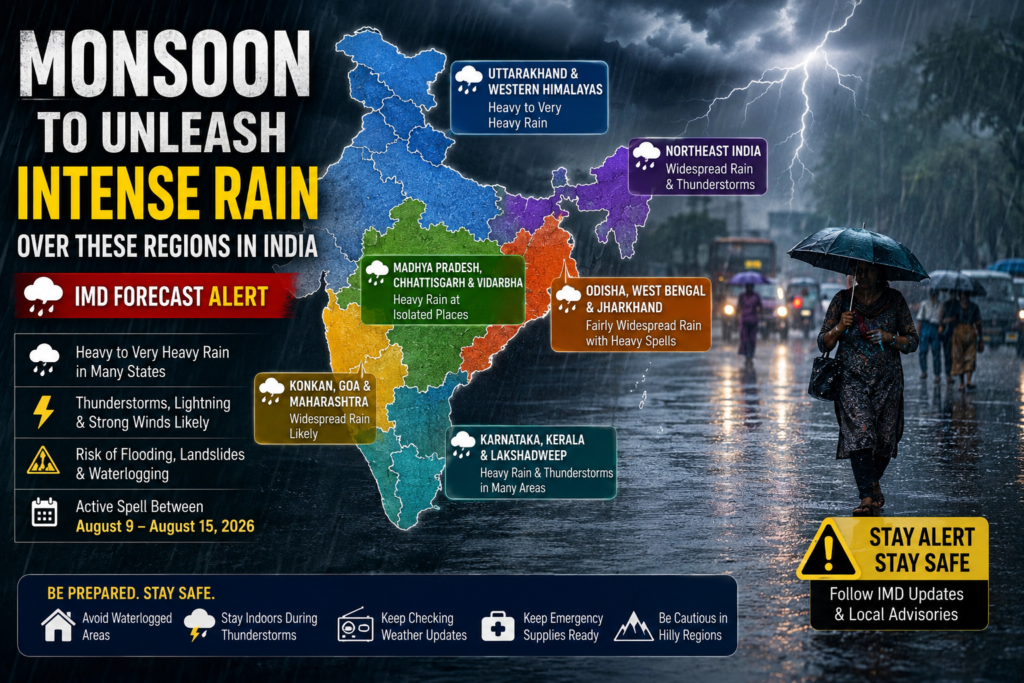
The monsoon to unleash intense rain over these regions in India forecast has raised concerns across several states as the India Meteorological Department (IMD) predicts heavy to very heavy rainfall in multiple parts of the country during the coming days.
According to the latest IMD update issued on August 9, 2026, the Western Himalayan region is likely to receive isolated heavy to very heavy rainfall during the week. At the same time, several parts of central and eastern India are expected to see periods of intense rainfall as active monsoon systems continue to influence weather conditions.
Monsoon to Unleash Heavy Rain Alert Over These Regions in India
The latest India weather forecast points to several regions that could receive significant rainfall between August 9 and August 15.
Uttarakhand and Western Himalayan Region
Uttarakhand remains one of the areas under close watch. The IMD has forecast heavy to very heavy rainfall at isolated places in Uttarakhand, particularly on August 9 and 10.
Himachal Pradesh, Jammu & Kashmir, Ladakh and surrounding areas are also expected to receive widespread rainfall during different periods of the week. Heavy rain alert may increase the risk of landslides, waterlogging and travel disruptions in vulnerable hilly areas.
Madhya Pradesh, Chhattisgarh and Vidarbha
Central India is another major focus of the current heavy rainfall forecast.
The IMD expects fairly widespread rainfall over eastern and western Madhya Pradesh and Vidarbha from August 9 to 11. Chhattisgarh is also likely to receive widespread rainfall on August 9-10, with another active spell possible from August 13-15.
Isolated very heavy rainfall is possible in western Madhya Pradesh, eastern Madhya Pradesh, Vidarbha and Chhattisgarh during the current spell.
The latest observations also show that these areas have already received significant rainfall. Chhattisgarh recorded 16 cm at Mungeli, while parts of eastern and western Madhya Pradesh recorded 15 cm and 14 cm respectively in the 24 hours ending August 9 morning.
Odisha and Eastern India
Odisha is also likely to remain wet. The IMD forecast indicates fairly widespread rainfall over Odisha on August 9-10 and again from August 13-15.
Heavy rainfall is possible at isolated locations during the wider August 9-15 period.
West Bengal and Jharkhand are also expected to receive rainfall during the week. Bihar could see increased rainfall activity particularly from August 13-15.
Northeast India
The Northeast India monsoon forecast also suggests periods of widespread rainfall.
Arunachal Pradesh, Assam, Meghalaya, Nagaland, Manipur, Mizoram and Tripura are expected to receive rain at different times during the week. Thunderstorms and lightning are also possible in several northeastern states.
The IMD has highlighted the possibility of heavy rainfall in Arunachal Pradesh, Assam and Meghalaya during specific periods, while Nagaland could also see very heavy rainfall in isolated locations.
Maharashtra, Konkan and Goa
Western India will not remain completely dry either. The IMD expects widespread rainfall over Konkan and Goa during August 9-15.
Madhya Maharashtra and Marathwada are also expected to receive rainfall during the week, with isolated heavy rain alert possible in parts of Madhya Maharashtra and Konkan and Goa.
The latest rainfall observations recorded 7 cm at Tamhini Mulshi in Pune district in Madhya Maharashtra.
Kerala and Karnataka
Southern parts of India are also likely to remain active during the monsoon spell.
The IMD expects fairly widespread to widespread rainfall over coastal Karnataka, Kerala, Mahe and Lakshadweep between August 9 and 15.
Heavy rainfall is possible at isolated places over coastal Karnataka, Kerala and southern interior Karnataka on August 9. Thunderstorms, lightning and strong winds are also possible in parts of southern India.
Why Is Rainfall Activity Increasing?
One of the important weather systems behind the current conditions is a low-pressure area that was positioned over northeast Madhya Pradesh and adjoining Chhattisgarh on the morning of August 9.
The IMD also expects a new cyclonic circulation to develop around August 11 over the northern Bay of Bengal and adjoining West Bengal-Bangladesh coast. A low-pressure area could form around August 13.
This system could increase rainfall activity over West Bengal, Odisha, Jharkhand, Chhattisgarh and Bihar from around August 13 onward.
Rainfall Could Affect Travel and Daily Life
Heavy rain Alert create several challenges, particularly in hilly and low-lying areas.
The IMD has warned about possible waterlogging, flooding, landslides, mudslides and reduced visibility in vulnerable locations. Strong winds and thunderstorms could also affect road and rail transportation.
People living in areas under heavy-rain warnings should monitor official weather updates and avoid unnecessary travel during severe weather.
In mountainous regions, travellers should be particularly careful because prolonged rainfall can increase the risk of landslides and road blockages.
What Should People Do During Heavy Rain?
Residents in affected regions should follow local weather alerts and disaster-management advisories.
Some basic precautions include:
- Avoid travelling through flooded roads and low-lying areas.
- Stay indoors during thunderstorms and lightning.
- Avoid taking shelter under isolated trees during lightning activity.
- Keep emergency supplies ready in flood-prone locations.
- Check road and transport conditions before starting a journey.
- Farmers should maintain proper drainage in fields to prevent prolonged waterlogging.
- People living in hilly areas should remain alert for landslides and falling debris.
The IMD has specifically advised people to monitor deteriorating weather conditions and be prepared to move to safer locations if necessary.
What Happens Next?
The current India monsoon forecast suggests that rainfall activity will remain significant across several regions through the coming week.
The Western Himalayas are likely to remain active, while central India could see another spell of heavy rain. Eastern India may experience an increase in rainfall around August 13 as a potential low-pressure system develops over the northern Bay of Bengal.
Therefore, residents and travellers should keep checking the latest IMD warnings because rainfall forecasts can change as weather systems develop.
Conclusion
The latest forecast confirms that the monsoon to unleash intense rain over these regions in India is not limited to one part of the country. Uttarakhand and other Western Himalayan areas, Madhya Pradesh, Chhattisgarh, Vidarbha, Odisha, parts of eastern India, the Northeast, Konkan and parts of southern India are all expected to experience periods of significant rainfall.
With heavy rain comes the possibility of flooding, waterlogging, landslides, lightning and transport disruptions. Staying updated with official weather alerts and following local safety instructions will be important as the monsoon remains active across India