As electricity prices continue to rise and people become more conscious about sustainable living, solar energy has emerged as one of the most reliable and cost-effective energy solutions. However, many people still get confused when comparing Solar Rooftop vs Solar Panels because these terms are often used interchangeably. While they are closely related, they are not exactly the same.
Understanding the difference between Solar Rooftop vs Solar Panels is important before investing in a solar energy system for your home or business. In this article, we will explain the meaning, working process, advantages, disadvantages, and major differences between rooftop solar systems and solar panels in simple language.
What Are Solar Panels?
Solar panels are devices that convert sunlight into electricity using photovoltaic (PV) cells. These panels absorb sunlight and generate direct current (DC) electricity, which is later converted into alternating current (AC) electricity with the help of an inverter.
Solar panels are the core component of any solar energy system and can be installed in different locations such as rooftops, open lands, solar farms, commercial buildings, and even portable solar setups.
Advantages of Solar Panels
- Generate clean and renewable energy
- Reduce electricity bills significantly
- Require low maintenance
- Environment-friendly energy solution
- Long lifespan of 20–25 years
Disadvantages of Solar Panels
- Initial installation cost can be high
- Performance depends on sunlight availability
- Requires sufficient installation space
- Efficiency may reduce during cloudy weather
What Is a Solar Rooftop System?
A solar rooftop system refers to a complete solar power setup installed specifically on the roof of a building. It includes solar panels, mounting structures, inverters, batteries (optional), and wiring systems.
In simple words, solar panels are one part of a solar rooftop system. A rooftop solar setup uses multiple solar panels to generate electricity directly from the rooftop space available in homes, offices, factories, or commercial buildings.
The popularity of rooftop solar systems has increased rapidly because they help users utilize unused roof space for energy production. Governments in many countries, including India, also provide subsidies and incentives for rooftop solar installations.
Solar Rooftop vs Solar Panels: Main Difference
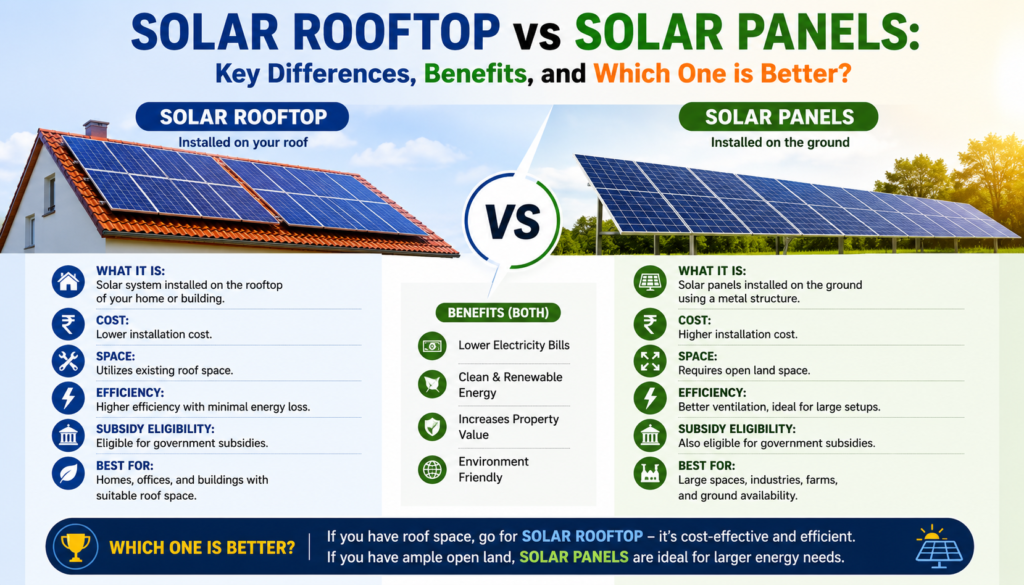
The biggest difference in Solar Rooftop vs Solar Panels is that solar panels are individual units that generate electricity, while a solar rooftop system is the complete setup installed on rooftops using multiple solar panels and supporting equipment.
| Feature | Solar Panels | Solar Rooftop System |
| Meaning | Individual photovoltaic units | Complete rooftop solar setup |
| Installation Area | Can be installed anywhere | Specifically installed on rooftops |
| Components | Only solar panels | Panels, inverter, mounting, wiring |
| Usage | Part of solar systems | Complete electricity generation system |
| Cost | Lower individual cost | Higher total setup cost |
| Energy Output | Depends on usage | Higher power generation capacity |
Benefits of Solar Rooftop Systems
1. Lower Electricity Bills
One of the biggest advantages of rooftop solar systems is reduced electricity costs. Homes and businesses can generate their own electricity and reduce dependency on grid power.
2. Better Use of Rooftop Space
Unused rooftop areas can be converted into energy-producing spaces without requiring additional land.
3. Government Subsidies
Many governments offer financial subsidies and tax benefits for rooftop solar installation, making it more affordable for consumers.
4. Eco-Friendly Energy Solution
Rooftop solar systems reduce carbon emissions and help protect the environment by using renewable energy.
5. Increased Property Value
Properties equipped with rooftop solar systems often have higher market value due to long-term energy savings.
Drawbacks of Solar Rooftop Systems
Although rooftop solar systems offer many benefits, there are some disadvantages as well.
High Initial Investment
Installing a complete rooftop solar system requires a significant upfront investment.
Roof Suitability Matters
Not every rooftop is suitable for solar installation. Factors such as roof direction, shadow areas, and roof strength affect performance.
Maintenance Requirements
Even though solar systems require low maintenance, regular cleaning and inspections are necessary for optimal efficiency.
Also Read : Why Your Passwords Are Putting You at Risk?
Which Is Better: Solar Rooftop vs Solar Panels?
The answer depends on your energy needs and installation goals. If you only want to understand the technology or purchase individual components, solar panels are the basic units you need. However, if your goal is to generate electricity for your home or business, a rooftop solar system is the practical and complete solution.
When comparing Solar Rooftop vs Solar Panels, it is important to remember that rooftop solar systems cannot function without solar panels, but solar panels alone do not form a complete power generation system.
For residential and commercial users looking for long-term electricity savings, rooftop solar systems are generally the better option.
Cost Comparison of Solar Rooftop vs Solar Panels
The cost difference between Solar Rooftop vs Solar Panels depends on several factors such as capacity, brand, technology, and installation type.
- Individual solar panels are comparatively cheaper because they are single components.
- Rooftop solar systems are more expensive because they include installation, inverters, mounting structures, batteries, and electrical setup.
However, rooftop solar systems provide better long-term value because they generate complete usable electricity for homes and businesses.
Future of Solar Energy
The future of solar energy looks extremely promising as governments and industries worldwide continue promoting renewable energy adoption. Rooftop solar installations are expected to increase significantly due to rising electricity costs and growing environmental awareness.
Modern solar technologies are also improving efficiency, battery storage, and affordability, making solar energy accessible to more consumers.
Experts believe that rooftop solar systems will play a major role in reducing dependence on fossil fuels and supporting sustainable energy development in the coming years.
Final Thoughts on Solar Rooftop vs Solar Panels
Understanding the difference between Solar Rooftop vs Solar Panels helps consumers make smarter energy decisions. Solar panels are individual energy-generating units, while rooftop solar systems are complete setups designed to power homes and businesses efficiently.
Both options have their own advantages and limitations, but rooftop solar systems provide a more practical solution for long-term energy savings and sustainable living.
As solar technology continues to evolve, investing in solar energy can become one of the best decisions for reducing electricity costs and supporting a greener future.
Also Read : West Bengal Chief Minister Suvendu Adhikari Takes Big Decision on First Day as New CM
Frequently Asked Questions (FAQs)
1. What is the main difference between Solar Rooftop vs Solar Panels?
The main difference between Solar Rooftop vs Solar Panels is that solar panels are individual photovoltaic units that generate electricity, while a solar rooftop system is a complete setup installed on rooftops using solar panels, inverters, wiring, and mounting structures.
2. Which is better: Solar Rooftop or Solar Panels?
If you want a complete electricity generation solution for your home or business, a rooftop solar system is the better option. Solar panels are only one component of the full system.
3. Can solar panels work without a rooftop solar system?
Yes, solar panels can work independently in smaller applications, but for powering homes or commercial buildings efficiently, a complete rooftop solar system is usually required.
4. How much money can be saved with a rooftop solar system?
Savings depend on electricity consumption and system capacity. In many cases, users can reduce their electricity bills by 50% to 90% after installing a rooftop solar system.
5. Do rooftop solar systems work during cloudy weather?
Yes, rooftop solar systems still generate electricity during cloudy weather, but their efficiency and power output may reduce compared to sunny conditions.