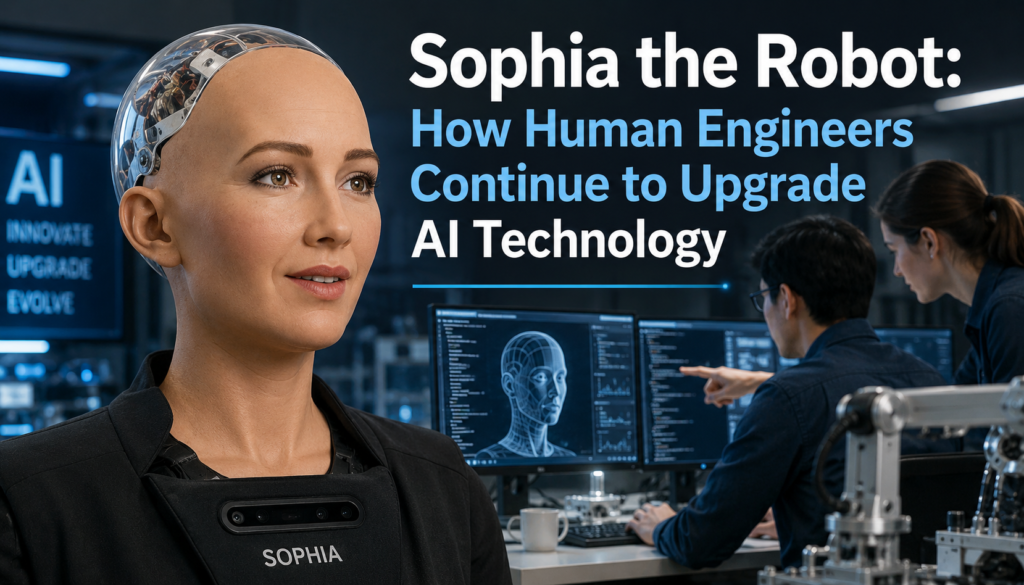
Artificial intelligence has moved past simple automation, way past it. The Sophia robot kind of stands out as one of the most recognized examples of human-centered robotics, even if people say it a bit too often. Built by Hanson Robotics, Sophia pulls together machine learning with computer vision, natural language processing, and some very advanced mechanical engineering. Human engineers keep pushing her forward through ongoing research, software development, and hardware upgrades. Lately, the updates suggest the robot still works as an important platform for AI experimentation and for human-robot interaction, not just a demo.
Meanwhile, the global AI industry keeps putting serious money into humanoid robotics, since organizations want machines that can interact in a more natural sort of way with people. Sophia has turned into a noticeable example of how artificial intelligence can be blended into a humanlike body. Researchers also use the whole platform to try out new technologies, the ones that might influence what the next generation of intelligent systems will become. Improvements in machine learning, speech processing, and robotics engineering get applied fairly regularly to make her more capable. And as AI adoption spreads across many industries, Sophia remains a useful study for figuring out the future relationship between humans and intelligent machines.
The Evolution of Sophia Robot
Since she got activated in 2016, Sophia the robot has kind of become a worldwide symbol for artificial intelligence. The engineers put a lot of effort into making her talk in a more natural way, read faces, keep eye contact, and join in conversations. Her lifelike facial reactions happen because of advanced robotics plus some specialized materials that Hanson Robotics developed, you know, specifically for that kind of look.
Honestly, the development story of Sophia Robot has never really stopped. Every year shows up with new software refinements, updated sensors, and more capable AI. Human engineers still treat her like a testing ground so they can explore what comes next for intelligent machines and all that.
Why Human Engineers Still Matter
A lot of people think AI systems can just upgrade themselves on their own, with no real help. But that’s not how it works. Human know-how stays the main engine behind each improvement seen in Sophia robot technology.
Engineers help out by doing things like:
– Building fresh hardware setups
– Making conversational AI models feel more consistent
– Upgrading facial recognition tech
– Creating mechanisms for emotional response
– Working on safer, human-robot contact
– Checking real-world performance through testing
Without ongoing human direction, Sophia Robot wouldn’t reach progress that actually means something. Each software release and mechanical enhancement gets planned, tested, and rolled out carefully by skilled researchers.
Advanced AI Systems that are powering the Sophia Robot
The “smarts” behind the Sophia robot really depend on a bunch of technologies that seem to work together, kind of in sync. Her overall setup uses computer vision systems, speech recognition tools, machine learning algorithms, and also some reasoning frameworks, though it’s not always the same emphasis day to day.
Some of the main tech pieces are basically these.
Natural Language Processing
With Natural Language Processing Sophia Robot can understand spoken language and then come back with responses that fit what’s being said. Engineers keep iterating on the language models to boost clarity and make conversations feel more natural.
Computer Vision
Through computer vision, Sophia is able to spot faces, track movement, and interpret what the cameras are seeing. Those cameras are placed in her “eyes,” and they feed visual information into the system. A lot of this gets improved over time via new AI models plus tweaks in sensor hardware.
Neural Network Systems
Deep learning models within the neural network systems let the Sophia robot detect patterns and handle conversations with smoother, more human-like timing. Researchers typically train the models on large datasets and then validate them through real-world testing in different environments.
Hardware Upgrades Driving Better Performance
It’s hard to say that artificial intelligence by itself can make a robot feel truly human or move the way we do. Sophia, you know, still needs the physical engineering side to evolve, like the body part matters as much as the “brain.”
Recently, a bunch of upgrades have been leaning toward things like
- More precise robotic arms
- Better motion control systems
- Enhanced touch sensors
- Improved mechanical flexibility
- Faster processing hardware
- Greater movement accuracy
In particular, researchers worked on advanced robotic arms so the Sophia robot AI could do more complex work, things such as sketching, handling objects, and even interactive demonstrations. With these changes, her value grows too; she becomes more useful as a research platform, not just a prototype that stands there.
Human-Robot Interaction Research
A key goal behind the Sophia robot is making human-robot communication better. Engineers look at how people react when a machine shows expressions, uses gestures, or behaves in a conversational way.
The research is mostly about:
- Emotional engagement
- Social communication
- Trust building
- Educational applications
- Customer service interactions
- Healthcare support possibilities
All of this helps engineers figure out how intelligent machines might work side by side with people in the next environments we’ll share.
New Areas of Development
The future of Sophia Robot doesn’t really stop at simple chatting. Instead, engineers keep looking into sort of creative ideas but also practical uses that can work in the real world and, you know, keep pushing forward.
Some emerging development areas are starting to show up, like:
Creative AI
Sophia has already shown what it can do with art and things like portrait drawing. In these projects it blends machine vision, robotic movement, and that AI-generated kind of imaginative output, even when the result looks more human than expected.
Enhanced Vision Systems
Researchers have been working on upgrades to computer vision systems, aiming for better environmental awareness and sharper object recognition. So basically Sophia can “notice” more and sort of categorize it faster.
Collaborative Intelligence
In the future, Sophia Robot might be able to link with broader AI networks. That could allow more advanced learning, plus knowledge sharing in a way that feels less isolated and more connected.
Challenges Facing Sophia Robot
Still, even with impressive progress, there are problems that don’t just disappear.
Some of them include:
- Contextual understanding limitations
- Complex emotional interpretation
- Real-time decision-making constraints
- Ethical concerns connected to AI
- Privacy and security requirements
- Human trust, and public acceptance issues
Engineers are still working through these obstacles using research, testing, and responsible development routines. Overall, the progress around Sophia Robot shows both the upside and the hard limits of today’s AI technology.
The Future Outlook
The ongoing development of Sophia Robot shows how human expertise and AI can sort of play together, even if it’s not always clear how. Engineers stay responsible for building the systems that end up shaping robotic behavior, communication, and learning too.
For what comes next, upgrades are expected to lean into more solid reasoning, better physical dexterity, richer conversations, and a deeper grasp of human emotions. If that works out, these advancements could ripple into industries from education and healthcare to customer engagement and even scientific research.
Also Read: Agentic AI Explained: The Next Big Shift
FAQs
1. What is the Sophia robot?
Answer: Sophia Robot is a social humanoid robot made by Hanson Robotics, kind of to show off the progress in artificial intelligence robotics and how humans interact with machines.
2. Who actually upgrades Sophia Robot
Answer: Usually it’s not one person; it’s teams of engineers, AI researchers, software developers, and robotics specialists who keep refining her hardware plus software systems, bit by bit.
3. Can the Sophia robot learn independently?
Answer: In a sense, yes, she can process information and adjust inside predefined systems, but the big upgrades and meaningful improvements are still planned and built by human engineers.
4. What technologies are used in the Sophia robot?
Answer: Some of the core techs are machine learning and computer vision, speech recognition, natural language processing, and advanced robotics engineering overall.
5. Why is Sophia Robot important, really
Answer: She supports researchers studying human-robot interaction, AI development, and the next wave of use cases for intelligent machines across many industries.