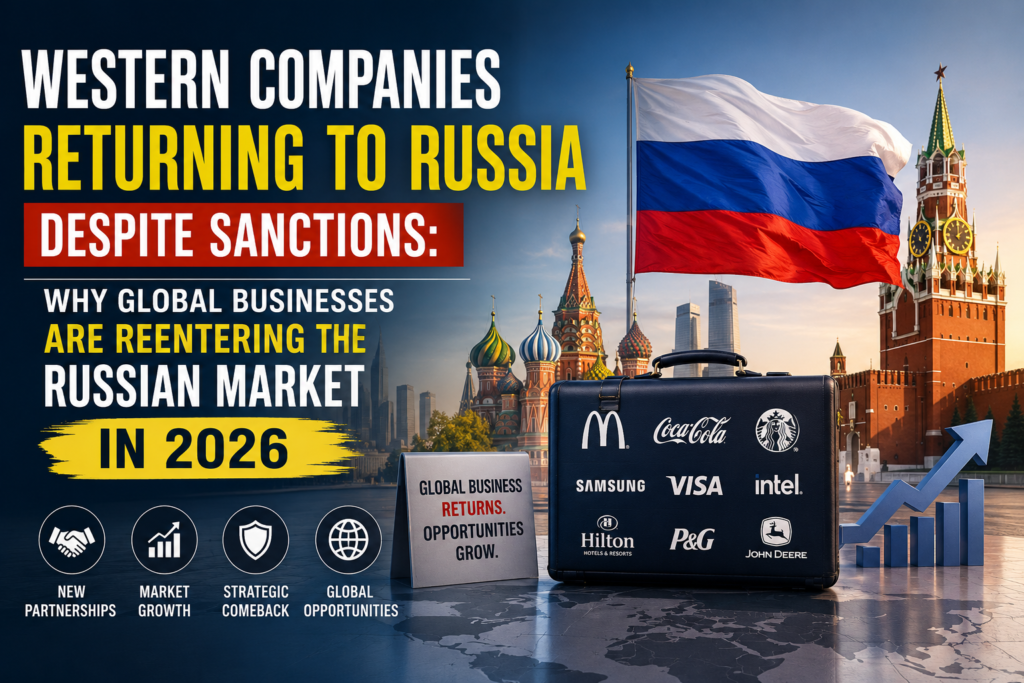
The global economy is changing really fast, and the idea of Western Companies returning to Russia has become one of the most talked about business movements in 2026. What once looked like a hard , almost total separation between Russia and Western corporations is now turning into a more tangled economic situation. Under the political headlines and the public, polished statements, a lot of international companies are rebuilding commercial connections quietly, repairing supply chains , and they are also searching for sideways routes to get back into the Russian market.
Today the picture is also different from what many analysts expected in the first phase of the Ukraine conflict. Back then, hundreds of global brands announced suspensions, departures, or operational shutdowns inside Russia. Big retail chains shut down stores , technology providers narrowed services, financial institutions reduced collaborations, and automakers paused production activities. Many people assumed Russia would stay economically separated from Western business networks for years and years.
Why the Russian Market Still Matters ?
Russia continues to sit among the world’s biggest consumer and industrial markets, and it’s not just a slogan. Millions of consumers keep buying electronics, luxury goods, automotive parts, industrial equipment, software services and different imported items. Even with sanctions, and the ongoing political tensions, demand inside the country never really went away in full.
For a lot of international companies, leaving Russia completely created another very specific headache. Rivals didn’t wait around. They moved in, fast, into that “empty” space.
Chinese companies were especially active, spreading into automobiles, electronics, telecommunications, and manufacturing, step by step and sometimes a bit too boldly. At the same time, Russian domestic brands managed to sharpen their positions in several industries. And Western corporations started noticing something practical: a long-term absence can cut their influence for good in one of the region’s larger economies.
So the commercial pressure didn’t just linger, it reshaped plans.
How companies are quietly coming back ?
Most businesses are not coming back with big public statements. Instead, they often work through distributors, intermediaries, regional partners, or parallel import systems, which sounds simple but it’s pretty complicated on the ground.
A lot of product movement happens through neighboring countries first, before it reaches Russian consumers. Some firms keep limited operations via subsidiaries that are based outside Russia. Others still rely on licensing agreements, or ongoing technology support, without advertising their presence too loudly in market.
This more discreet style lets companies keep commercial activity, while sidestepping major political attention, or at least reducing it.
And in quite a few situations, consumers inside Russia can still find international products, even when official stores or offices no longer operate openly.
The Role of Chinese Competition
One of the biggest reasons behind renewed Western attention, is the rapid rise of Chinese businesses inside Russia, like suddenly everywhere at once and not always with the same rhythm. Chinese automotive brands gained a lot of market share after Western car manufacturers scaled down their presence. Chinese electronics companies increased exports at a notable pace. Technology providers also expanded their reach across industrial systems, telecommunications, and everyday consumer devices.
For Western corporations, the worry is not only short term revenue loss. It’s also about control later on, the longer play really.
If competitors manage to build stronger ties with Russian consumers and industries over several years, returning later could become a lot harder than people assume. This is what pushed some global companies to, quietly, rebuild supply channels before they lose their position completely.
Energy and Resources Continue Driving Business
Russia is still one of the world’s most important suppliers of oil, gas, fertilizers, metals, and industrial raw materials. A lot of international industries still depend, in some form, on access to resources that are tied to Russia.
Manufacturing sectors across Europe and Asia keep getting squeezed by higher production costs and supply chain instability. Companies connected to heavy industry, agriculture, chemicals, and transportation often cannot just completely disconnect from Russian markets without paying more in operational expenses, even if the plan sounds clean in theory.
In the end economic reality keeps shaping corporate decisions even while sanctions are still active and in place.
Technology Companies Face Difficult Choices
Tech companies work in one of the most complicated corners of the sanctions picture, like it’s never simple, and honestly, Russia is still a big destination for software systems, industrial automation, cybersecurity tools, semiconductors, cloud infrastructure, and consumer electronics.
Meanwhile the momentum from artificial intelligence plus digital backbone has made tech influence feel more and more valuable worldwide. Many organizations now treat access to digital markets as a real chance for revenue, but also as a kind of strategic leverage.
So a lot of firms keep looking for lawful routes to keep some business activity alive while also staying within international compliance rules.
At the same time, administrations keep watching technology exports very closely, because they worry about security issues and potential military uses, not just the civilian story.
Luxury Brands Continue Seeing Demand
Luxury goods still look oddly steady in Russia, even with political and economic constraints sitting there in the background.
Wealthy customers continue buying premium fashion, jewelry, watches, cosmetics, and lifestyle items through indirect import routes. Basically the desire for luxury brands never just vanished, it was more like buying behavior shifted toward intermediaries, and overseas purchasing networks.
Some global luxury houses now have a tougher dilemma. If people are already getting the products through unofficial channels, does cutting the market off completely still even add up as a business move?
This argument keeps steering how companies plan long range decisions across the luxury sector.
Political Pressure Still Exists
Governments across Europe and North America keep enforcing sanctions and monitoring international trade that somehow links back to Russia. Companies accused of breaking these limits, can face financial penalties, reputational harm, and yes, possible legal investigations too.
At the same time, public criticism still feels strong in plenty of places, like it’s not really fading.
Now, large corporations operate in this awkward kind of tradeoff, between politics and profitability, kind of a moving target. Investors want growth. Consumers are still buying products. Rivals aggressively chase market openings. But the company also has to keep an eye on its public image and stay compliant with regulations that change, sometimes fast, sometimes subtly, sometimes all at once.
So, this balance thing, has become one of the biggest corporate difficulties in the current geopolitical atmosphere.
A More Fragmented Global Economy
Also, the world economy is changing quickly, not just slowly in the background. Countries are forming fresh trade agreements, building alternative payment tools, and joining regional economic blocs that sit outside older Western patterns.
Groups like BRICS keep talking about independent financial systems, and non-dollar trade arrangements. Regional trade corridors across Asia and the Middle East are gaining more weight. Less influence from a single lane of power. More from multiple directions, basically.
For businesses, that means adapting to a situation where economic leverage is not controlled entirely by one collection of countries. This shift is already steering global trade choices, investment thinking, and even the nitty-gritty of supply chain planning.
Also Read More About: From Drain Memes to Digital Revolution: The Rise of Cockroach Janta Party
The Future of Global Business in Russia
Some firms will keep steering away from Russia, because of ethical worries, regulatory exposure, or just public pressure that won’t go away. Other businesses might expand more quietly, where the legal window remains open.
And honestly, the whole scenario keeps shifting , month by month.
In 2026, one reality feels like it has become clearer, in a way that is hard to unsee. Global business decisions are no longer, shaped only by politics, not quite. Market demand and strategic resources are now right there alongside it, same weight almost. Then add technological competition, and also longer horizon economic influence. Put it all together, and it’s pretty much an equally powerful mix in deciding where companies actually decide to operate.